

Written by
John Progar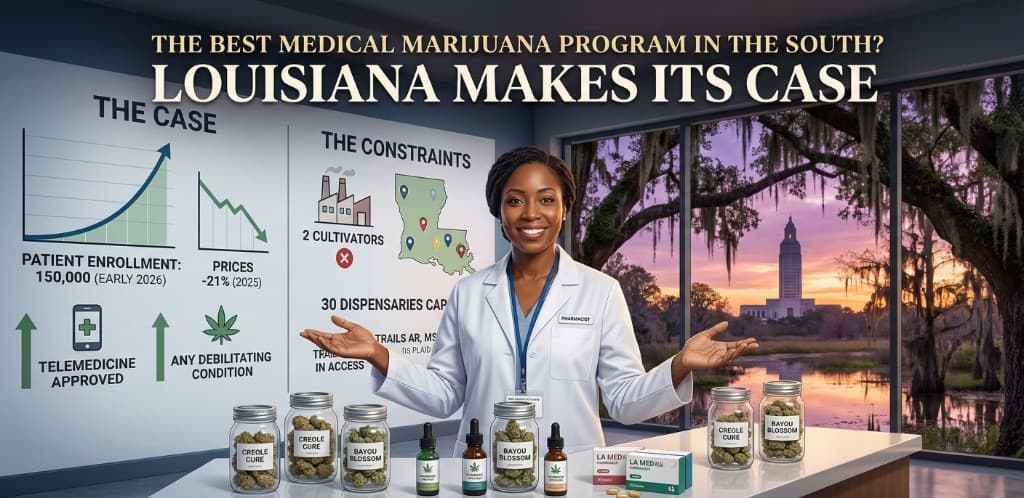
Louisiana's once-restrictive medical marijuana program has transformed into what industry leaders call "the best in the South," with nearly 150,000 enrolled patients — 3.2% of the state's population — as of early 2026. Patient counts more than doubled between Q1 2024 and Q4 2025, product prices fell roughly 21%, and a new bill (HB 373) now proposes a recreational cannabis pilot program through 2030. Yet the program remains constrained by a producer duopoly, a dispensary cap of 30 locations, and political dynamics that keep full legalization at arm's length. For patients considering certification, Louisiana offers one of the most streamlined entry points in the country: no state registration fee, no physical card requirement, telemedicine consultations permitted, and a qualifying-conditions list so broad that any physician-deemed "debilitating" condition qualifies.
From Restrictive Origins to Rapid Growth
Louisiana first enacted therapeutic marijuana legislation in 1978, but the law remained non-functional for decades. The modern program traces to the Alison Neustrom Act of 2015 (Act 261), which designated the LSU Agricultural Center and Southern University Agricultural Center as the state's only two licensed production entities. First patient sales did not occur until August 2019, limited to non-smokable forms: tinctures, capsules, oils, topicals, and edibles.
The program's trajectory changed dramatically through a series of legislative expansions. HB 819 (Act 286 of 2020) opened the qualifying conditions to any physician-deemed debilitating condition and allowed any licensed physician to recommend cannabis, eliminating prior specialist requirements. Act 424 of 2021 legalized raw, smokable flower effective January 1, 2022, triggering a 77% surge in prescriptions and 45% increase in patients within weeks. HB 697 (Act 491 of 2022), sponsored by Rep. Tanner Magee (R-Houma), passed with bipartisan support (House 77-16, Senate 22-12) and restructured the entire program: it moved regulatory authority to the Louisiana Department of Health, expanded potential dispensary locations from 10 to 30 through satellite provisions, authorized telemedicine recommendations, and mandated home delivery services.
Patient enrollment tells the growth story most vividly. From approximately 3,000 patients at the 2019 launch, the program grew to 14,000 by 2021, 30,000 by 2023, 53,292 by January 2025, and approximately 150,000 by late 2025, according to data presented by Good Day Farm President John Davis at a Baton Rouge Rotary Club meeting on February 25, 2026, as reported by both The Advocate and Baton Rouge Business Report. Davis characterized the program as having "matured, scaled, and most importantly...we're safe, we're consistent, we're regulated."
How the Regulatory Framework Was Rebuilt in 2024-2025
The 2024 legislative session produced the most significant structural reforms since the program's inception. SB 228 (Act 150 of 2024), sponsored by Sen. Patrick McMath (R-Covington) and signed by Governor Jeff Landry on May 22, 2024, accomplished two critical things: it extended the program's sunset date from January 1, 2025 to July 1, 2030, and it removed the universities from the manufacturing chain entirely, transferring cultivation licenses directly to the private operators, Good Day Farm Louisiana LLC and Advanced Biomedics LLC (dba Ilera Holistic Healthcare). The bill passed overwhelmingly (Senate 32-5, House 89-1).
HB 376 (Act 693 of 2024) completed the regulatory consolidation by transferring authority over marijuana retailers from the Louisiana Board of Pharmacy to the Louisiana Department of Health, effective January 1, 2025. This act also renamed "therapeutic marijuana pharmacies" as "retailers," raised the total allowable retail locations to 30, and mandated delivery service to patients at least once monthly. The bill passed unanimously in the House (101-0) and was signed into law in June 2024. LDH published its comprehensive Medical Marijuana Final Rule in January 2026, codifying the new regulatory framework.
The current oversight structure is now consolidated under the LDH Cannabis Program (Office of Public Health, Bureau of Sanitarian Services), which handles cultivation inspections, product testing review, retailer permitting, and laboratory licensing. The state uses Metrc, a seed-to-sale tracking system, to monitor all cannabis from production to point of sale. A 17-member advisory board mandated by state law provides program oversight.
Additional 2024 legislation included HB 165, which reduced marijuana paraphernalia penalties (first offense fine dropped from $300 to $100 with no imprisonment), and HB 952 (Act 752), which imposed new restrictions on hemp-derived THC products, lowering per-serving THC from 8mg to 5mg, capping packages at 40mg, banning hemp flower sales, and prohibiting hemp-THC sales at gas stations. These hemp restrictions, effective January 1, 2025, do not apply to medical marijuana products. A recreational legalization bill, HB 978, failed on the House floor 36-58, but notably became the first cannabis regulation bill to receive a floor vote in any Deep South legislature.
Two Producers, Roughly 23 Dispensaries, and a Duopoly Debate
Louisiana's production landscape remains uniquely constrained. Only two licensed manufacturers operate in the state, and no mechanism exists for additional companies to apply unless a current licensee relinquishes its license.
Good Day Farm Louisiana LLC (formerly GB Sciences Louisiana) operates a 225,000-square-foot facility in Ruston that has undergone multiple expansions, most recently reaching a capacity of approximately 5,700 pounds of product per month with over 70,000 square feet of canopy housing 16,000+ plants. The company invested over $50 million in Louisiana operations in 2022 alone and employs 220+ workers at its Ruston facility. Good Day Farm also operates six dispensary locations (Shreveport, Bossier City, Jennings, Lake Charles, Natchitoches, and Sulphur), including a 10,000-square-foot retail location in Lake Charles described as the largest dispensary in the South. Between April 2018 and January 2024, Good Day Farm paid LSU AgCenter approximately $7.57 million in fees and research investments.
Advanced Biomedics LLC (dba Ilera Holistic Healthcare), a partnership between Pennsylvania-based Ilera Healthcare and Washington, D.C.-based National Holistic Healing Center, operates a growing facility on Plank Road in Baker, near Baton Rouge. Led by CEO Chanda Macias, the company launched the THC brand AYO and hemp-derived CBD line ALAFIA. Between FY 2019-2024, Ilera paid Southern University AgCenter approximately $7 million (minimum $1 million/year or 5% of gross proceeds).
On the retail side, the state currently has approximately 22-23 operational dispensary/retailer locations distributed across Louisiana's nine LDH health regions, with capacity to grow to the 30-location statutory cap. Major retail operators include:
- Good Day Farm: 6 locations in northwest and southwest Louisiana
- NOLA Cannabis (formerly H&W Drug Store): 3 locations in the greater New Orleans area (New Orleans, Metairie, Kenner)
- The Apothecary Shoppe: 3 locations in Acadiana (Lafayette, New Iberia, Opelousas)
- Willow Pharmacy: 3 locations on the North Shore (Slidell, Covington, Hammond)
- The Medicine Cabinet Pharmacy: 3 locations in central Louisiana (Alexandria, Leesville, Marksville)
- Capitol Wellness Solutions: Baton Rouge
- Green Leaf Dispensary: Houma
- Delta Medmar: West Monroe
- Hope Pharmacy: Shreveport
The duopoly structure has drawn pointed criticism. Former state Rep. Joe Marino called SB 228 a move to "tighten their monopoly and risk increased costs." Media investigations have highlighted that Good Day Farm's primary shareholder is Boysie Bollinger, one of Louisiana's wealthiest individuals and a major Republican donor, while the company's president, John Davis, is the husband of state Rep. Paula Davis (R-Baton Rouge), who recuses herself from marijuana-related votes. A Louisiana Legislative Auditor report found that Southern University's AgCenter spent only $287,000 on research grants out of $4.4 million in total program spending, with $2.7 million going to "other expenditures." These connections and spending patterns have fueled ongoing debate about whether the program's tight licensing structure serves patients or primarily benefits incumbent operators.
Patient Certification Is Remarkably Simple, and Affordable
Louisiana operates one of the most frictionless patient certification systems in the nation. There is no physical medical marijuana card, no state registration fee ($0), and no separate state registry that patients must join. The physician's signed recommendation, entered into the state's Prescription Monitoring Program (PMP) database, serves as the patient's sole authorization to purchase cannabis at any licensed retailer.
The certification process involves four steps. A patient schedules an appointment — in-person or via telemedicine — with an authorized clinician. Three categories of clinicians can recommend medical marijuana: physicians licensed by the Louisiana State Board of Medical Examiners, nurse practitioners with prescriptive authority licensed by the Louisiana State Board of Nursing (added in 2022 by Act 444), and medical psychologists licensed by the LSBME. The clinician evaluates the patient's medical history, qualifying condition, and prior treatments. If approved, the recommendation is entered directly into the PMP database and sent to the patient's preferred retailer. The patient then visits the retailer with a valid Louisiana government-issued ID to purchase products. Recommendations are valid for up to 12 months and can be renewed via telemedicine.
Telemedicine has been a transformative force for the program. Codified in La. R.S. 40:1046(K), the law explicitly states that nothing shall prevent an authorized physician from recommending therapeutic marijuana through telemedicine. A bona fide clinician-patient relationship can be established during the telemedicine consultation itself. This provision, solidified through HB 819 in 2020, has been instrumental in the program's explosive growth, particularly for rural patients who previously faced hour-long drives to access recommending physicians.
Physician consultation fees typically range from $100 to $400 for new patients, with renewals running $99 to $250. MMJ.com charges $149.99 for evaluations. There is no additional state fee. At the dispensary level, the average product price across flower, tinctures, vape devices, and edibles is approximately $47, with an eighth (3.5g) of flower running $35-$85 and high-quality ounces priced around $200-$359. A 7% excise tax on gross sales applies, plus standard state sales tax on smokable flower. Medical marijuana prices have dropped approximately 21% from mid-2024 to January 2026, according to Good Day Farm data.
All 26 Qualifying Conditions and the Catch-All Provision
Louisiana recognizes 26 specific qualifying medical conditions, plus hospice and palliative care eligibility, and a critical catch-all provision. The named conditions are: cancer, glaucoma, Alzheimer's disease, amyotrophic lateral sclerosis (ALS), Huntington's disease, Lewy body dementia, motor neuron disease, Parkinson's disease, spinal muscular atrophy, HIV/AIDS, cachexia or wasting syndrome, seizure disorders, epilepsy, spasticity, severe muscle spasms, intractable pain, Crohn's disease, muscular dystrophy, multiple sclerosis, PTSD, autism spectrum disorder (with specific behavioral severity criteria), traumatic brain injury, physician-diagnosed concussion, chronic pain from fibromyalgia, and chronic pain from sickle cell disease.
Beyond these named conditions, HB 819 (2020) added the provision that any authorized clinician may recommend medical marijuana for any condition they deem debilitating based on their medical training and judgment. This effectively makes Louisiana's qualifying conditions list open-ended — a feature that distinguishes it from more restrictive programs in neighboring states. Patients must be Louisiana residents with valid state-issued identification, and those under 18 require parental/guardian involvement plus consultation with a pediatric subspecialist for autism-related recommendations.
Market Economics Remain Opaque but Point Upward
Hard revenue data for Louisiana's medical marijuana market is limited because the state does not publicly report comprehensive sales figures. Available tax collection data shows Louisiana collected $993,000 in cannabis tax revenue in 2023, a 61.2% increase from approximately $616,000 in 2022. At the program's 7% excise tax rate, the 2023 tax figure implies roughly $14.2 million in taxable wholesale sales, though the precise tax base calculations may differ depending on how the $3.50/gram retail tax is factored.
Earlier industry projections appear significantly overstated. The 2021 MJBizDaily Factbook estimated $330-$400 million in annual sales by 2025, but actual figures likely fall well below that range. With patient counts roughly tripling between January 2025 (53,292) and late 2025 (~150,000), however, 2025 revenue will represent a substantial jump. Good Day Farm alone produced approximately 17,000 pounds of cannabis in 2022 and invested $50+ million in Louisiana operations that year, suggesting significant economic activity even if aggregate sales data remains unreported.
Job creation is concentrated around the two manufacturers and expanding retail network. Good Day Farm's Ruston facility employs 220+ workers with plans for up to 200+ additional positions as the market matures. Dispensary operations, cultivation, processing, and ancillary services collectively support hundreds of additional jobs statewide. The two universities received a combined $14.57 million from their private partners between 2018-2024 before being removed from the manufacturing chain.
Louisiana Trails Arkansas and Mississippi Despite Head Start
Louisiana's program, despite launching sales the same year as Arkansas (2019) and well before Mississippi (2023), lags its neighbors on key access metrics. Arkansas has enrolled approximately 115,113 active patients, operates 37 dispensaries, and generated a record $291.1 million in sales in 2025, producing $32.3 million in state tax revenue and surpassing $1.6 billion in cumulative sales since inception. Louisiana patients have reported that products are available at roughly half the price in Arkansas. Mississippi, with sales beginning only in January 2023, has already surpassed Louisiana in both dispensary access (193 dispensaries) and approximate patient count (~63,000 as of September 2025), enabled by a far more open licensing structure.
Texas remained one of the nation's most restrictive programs until June 2025, when Governor Abbott signed HB 46, creating a comprehensive medical cannabis framework with expanded qualifying conditions (adding chronic pain, Crohn's, TBI, and terminal illness), raised THC limits to 10mg per dose, and authorized expansion from 3 to 15 dispensing organizations. Texas now has approximately 135,470 patients in its Compassionate Use Registry, though active participants are estimated at 30,000-40,000. Alabama remains the laggard: though the Medical Cannabis Commission approved dispensary licenses in December 2025, first sales are not expected until spring 2026, with only 1 patient registered as of late 2025. Florida operates in a different league entirely, with approximately 930,779 patients, 737 dispensary locations, and $1.65 billion in 2025 sales.
Louisiana's limited licensing structure — 2 cultivators versus Mississippi's multiple tiers and 30 maximum retail locations versus Mississippi's 193 — is the primary driver of these disparities. The Marijuana Policy Project has noted that Louisiana's "very limited number of producers and dispensaries and other restrictions continue to drive up prices and unnecessarily restrict patient access."
HB 373 and SB 270: The 2026 Legislative Push
The most significant development as of late February 2026 is HB 373, filed on February 25 by Representative Candace Newell (D). The bill would establish the "Adult-Use Cannabis Pilot Program Regulation and Enforcement Act," authorizing sales to adults 21 and older through a temporary state-run pilot program running January 1, 2027 through July 1, 2030. The Louisiana Department of Health would oversee the program, and participation would be limited to existing medical marijuana operators, with no new licenses issued. Each of the 10 licensed retail operators could designate one location per region for adult-use sales, with existing cultivators eligible to supply both medical and recreational products.
The bill's tax structure offers a financial incentive: participating cultivators would pay a reduced 3.5% fee on gross wholesale sales versus the current 7% for medical-only operators. Revenue would be deposited into the state's Disability Services Fund, and adult-use retail sales would be subject to standard sales and use taxes while medical sales remain exempt. A $5,000 annual permit renewal fee per participating location would apply. HB 373 has been referred to the House Health and Welfare Committee.
The recreational pilot is not the only notable bill of the 2026 session. Senate Bill 270, filed by State Senator Katrina Jackson-Andrews (D), would require licensed healthcare facilities to allow terminally ill patients — defined as those with a prognosis of one year or less — to use medical marijuana while receiving care. The bill would enact R.S. 40:1046.5 and mandate that facilities document marijuana use in the patient's medical record and develop written guidelines governing its use. Smoking and vaping would be prohibited as administration methods within facilities. The proposal includes a safeguard allowing facilities to suspend compliance if a federal agency, the DOJ, or CMS initiates enforcement action. If approved, SB 270 would take effect August 1, 2026, representing a meaningful expansion of where and how terminally ill patients can access their medicine.
HB 373 is a successor to the failed HB 627 from the 2025 fiscal session, which died in committee. The 2026 regular session does not carry the fiscal-session restrictions that limited cannabis legislation in 2025, giving both bills a better procedural path. Public polling supports legalization: 70% of LSU poll respondents favor adult-use cannabis, up from 42% in 2013. However, Governor Landry's conservative administration, which vetoed HB 391 (a cannabis pardon bill) in 2024, presents a significant political obstacle. Critics have also attacked HB 373's operator-only licensing approach as "a monopoly in plain sight" that excludes small businesses, local entrepreneurs, and minority-owned startups.
Federal Rescheduling Adds a New Variable
Beyond the state-level legislative push, a major federal development is reshaping the broader landscape for Louisiana's program. In December 2025, an executive order directed federal agencies to begin moving marijuana from Schedule I to Schedule III under the Controlled Substances Act. On January 6, 2026, the DEA clarified that while the executive order provides direction and momentum, the rescheduling process is not yet legally complete and must still go through required administrative steps. Federal agencies are currently preparing regulations and guidance, including updates to research approvals and law enforcement instructions. Rescheduling is expected to be officially finalized within the first half of 2026.
For Louisiana patients, federal rescheduling does not change day-to-day access: the state's recommendation-based system, qualifying conditions, and retail framework remain governed entirely by state law. However, the downstream effects could be significant. Moving marijuana to Schedule III would formally recognize its medical value at the federal level, potentially opening new avenues for clinical research, easing banking restrictions that have plagued cannabis businesses nationwide, and eliminating the IRS Section 280E tax burden that prevents cannabis companies from deducting standard business expenses. For Louisiana's two licensed cultivators and expanding dispensary network, these changes could improve financial stability, attract investment, and lower the operational costs that currently contribute to higher patient prices.
The rescheduling process also intersects with Louisiana's HB 373 pilot program. If marijuana moves to Schedule III before the proposed January 2027 launch of adult-use sales, the regulatory environment for a recreational pilot could be considerably more favorable — both politically and operationally — than it would be under the current Schedule I classification.
Persistent Challenges Cloud an Otherwise Maturing Program
Despite impressive growth, several structural issues constrain the program. The duopoly production model limits competition, and no pathway exists for new cultivators unless current licensees exit. While prices have fallen 21%, Louisiana products remain more expensive than those in Arkansas and other states with more competitive markets. Dispensary access in rural areas remains challenging, with patients in some parishes driving over an hour to reach a retailer, and reports of four-hour wait times at some locations. The delivery mandate in Act 693 addresses this partially but has not fully resolved geographic access gaps.
Regulatory bureaucracy has been another friction point. Operators have reported monthslong waits for approvals on new standard operating procedures and complaints about micromanagement, including the Louisiana Department of Agriculture and Forestry previously requiring changes to trivial documentation details before the LDH takeover. The multiple transfers of regulatory authority (from LDAF and the Board of Pharmacy to LDH) created transitional confusion, though the January 2026 Final Rule aims to provide regulatory clarity going forward.
The absence of comprehensive employment protections remains a concern for patients. While state employees gained some protections through Act 651 (HB 988 of 2022), private-sector workers lack broad legal shields for off-duty medical marijuana use. Insurance coverage for medical marijuana products does not exist due to marijuana's federal Schedule I status (though pending rescheduling to Schedule III could eventually change this dynamic), meaning all patient costs — consultations and products alike — are entirely out of pocket. The conflict between the medical marijuana industry and hemp-derived THC market also continues, with medical marijuana operators lobbying for stricter hemp regulations to reduce price competition while hemp advocates argue for consumer choice.
Conclusion
Louisiana's medical marijuana program has undergone a remarkable transformation from an inaccessible, non-functional framework to a rapidly growing system serving 150,000 patients. The 2024-2025 legislative reforms, consolidating regulation under LDH, extending the sunset to 2030, and separating universities from production, created structural stability that enabled the recent patient surge and price declines. The 2026 session is pushing the envelope further, with HB 373's recreational pilot proposal and SB 270's terminally-ill-patient access bill both signaling that the political conversation is evolving. Meanwhile, the federal rescheduling of marijuana from Schedule I to Schedule III, expected to finalize in the first half of 2026, could unlock research funding, ease banking restrictions, and improve the financial footing of Louisiana's operators and patients alike.
Yet the program's fundamental tension between tight regulation and patient access remains unresolved. With only two producers and a 30-dispensary cap serving a state of 4.6 million people, Louisiana lags neighbors like Arkansas and Mississippi on competition and access metrics despite its head start. For patients, the immediate outlook is positive: declining prices, expanding retail locations, broad qualifying conditions, and a $0-fee, telemedicine-friendly certification process that ranks among the easiest in the South.
Louisiana Medical Marijuana Resources:
- Get Your Louisiana Medical Marijuana Card
- Find a Louisiana MMJ Doctor
- Louisiana Qualifying Conditions
- Louisiana Dispensary Directory
- Louisiana Cannabis Prices
- Louisiana MMJ Card Renewals
- Louisiana Cannabis Laws
Ready to access Louisiana's medical cannabis program? MMJ.com connects Louisiana patients with licensed physicians who can evaluate you for a medical marijuana recommendation through convenient telehealth appointments. Get started today with same-day appointments and our 100% money-back guarantee.
About the Author
This article was written by the MMJ.com Medical Team, a group of licensed healthcare professionals specializing in medical cannabis certification. Our team has helped over 10,000 patients obtain their medical marijuana cards.