Laws

Ohio Medical Marijuana Law: Understanding HB 523 and the Initiative That Started It All

MMJ.com Medical Team
13 min read
John Progar

Written by

John Progar
Share:

Ohio's medical marijuana program has come a long way since a group of advocates first proposed legalizing cannabis for patients with debilitating conditions. What began as a citizen-led ballot initiative in 2015 eventually became House Bill 523, the law that established the Ohio Medical Marijuana Control Program (OMMCP) and opened the door for hundreds of thousands of Ohioans to access medical cannabis.

This guide covers everything you need to know about the law that made it all possible, including the qualifying conditions it established, how the program works today, and how to get your Ohio medical marijuana card online with MMJ.com.

What Is Ohio HB 523?

House Bill 523 is the legislation that legalized medical marijuana in Ohio. Sponsored by Representative Stephen Huffman, along with co-sponsors Charleta Tavares, Tim Brown, and John Rogers, the bill passed both the Ohio House (71-25) and Ohio Senate (19-15) in late May 2016. Governor John Kasich signed HB 523 into law on June 8, 2016, making Ohio the 25th state in the nation to establish a legal medical marijuana program.

The law went into effect on September 8, 2016, and created a comprehensive regulatory framework for the cultivation, processing, testing, and dispensing of medical marijuana products to qualifying patients.

HB 523 did not emerge in a vacuum. It was the legislature's response to a growing ballot initiative campaign that was gaining momentum and public support. Legislators chose to craft their own version of medical marijuana legalization rather than leave the issue to a ballot measure, which they felt could be less carefully regulated. The result was one of the more tightly controlled medical cannabis programs in the country.

What the Law Established

HB 523 created a "seed to sale" regulated system with oversight distributed among three state agencies:

Ohio Department of Commerce was tasked with licensing cultivators, processors, and testing laboratories through its Division of Cannabis Control (formerly the Division of Marijuana Control). The Department was given until March 2017 to adopt rules for cultivators and testing labs.

Ohio Board of Pharmacy (later restructured under the Department of Commerce) was charged with regulating dispensaries, creating the patient and caregiver registry, and overseeing the retail side of the program. The Board had until September 2017 to finalize its rules.

State Medical Board of Ohio was assigned responsibility for maintaining the list of qualifying medical conditions and certifying physicians who could recommend medical marijuana to their patients. The Board established the Certificate to Recommend (CTR) system that remains in use today.

The law also set parameters for how patients could use medical marijuana. When originally passed, HB 523 prohibited smoking raw cannabis but allowed vaporization, edibles, oils, tinctures, patches, and topical applications. Patients were limited to a 90-day supply at a time, dispensed in 45-day fill periods. (Note: This tier-based system was replaced effective March 24, 2026, with a simplified daily transaction limit — see current limits below.)

Vertical integration was permitted, meaning a single entity could hold licenses for cultivation, processing, and retail. The law also included a provision requiring that 15% of cultivator, processor, and laboratory licenses be issued to businesses owned by members of economically disadvantaged groups.

The Original Ballot Initiative

Before HB 523, the Marijuana Policy Project (MPP) partnered with Ohio advocates to form Ohioans for Medical Marijuana, a campaign organization dedicated to placing a medical marijuana constitutional amendment on the November 2016 ballot.

The initiative went through multiple drafts. The campaign submitted its first proposed amendment to Ohio Attorney General Mike DeWine for certification in late 2015, and after receiving feedback and revising the language, resubmitted an improved version in early 2016. The Ohio Attorney General certified the petition, and the Ohio Ballot Board subsequently approved it as a single-issue measure, clearing the way for signature collection.

The initiative text proposed a broader program than what legislators ultimately passed. Key differences included stronger employment protections for patients, more expansive qualifying conditions, and constitutional-level protections that would have been more difficult for future legislatures to modify.

As Ohioans for Medical Marijuana began collecting signatures and polling showed strong public support (with some surveys indicating around 90% of Ohio voters favored legalizing medical marijuana), lawmakers felt pressure to act. Rather than allowing voters to enshrine cannabis protections in the state constitution, the General Assembly moved quickly to pass its own version through the legislative process.

When HB 523 passed with enough support to demonstrate legislative commitment, Ohioans for Medical Marijuana suspended its signature collection campaign in late May 2016. The campaign acknowledged that while the legislative bill was "imperfect," it represented a meaningful step forward for Ohio patients. The organization continued to advocate for improvements to the law and kept its infrastructure in place in case the legislature failed to implement the program effectively.

Qualifying Conditions Under Ohio Law

When HB 523 was first enacted, it specified 21 qualifying medical conditions. That list has since been expanded through an annual petition process managed by the State Medical Board of Ohio. As of 2026, there are 26 recognized qualifying conditions for an Ohio medical marijuana card:

  • AIDS
  • Alzheimer's disease
  • Amyotrophic lateral sclerosis (ALS)
  • Cachexia
  • Cancer
  • Chronic traumatic encephalopathy (CTE)
  • Crohn's disease
  • Epilepsy or another seizure disorder
  • Fibromyalgia
  • Glaucoma
  • Hepatitis C
  • Huntington's disease
  • Inflammatory bowel disease (IBD)
  • Irritable bowel syndrome (IBS)
  • Multiple sclerosis (MS)
  • Pain that is either severe, chronic, or intractable
  • Parkinson's disease
  • Positive status for HIV
  • Post-traumatic stress disorder (PTSD)
  • Sickle cell anemia
  • Spasticity
  • Spinal cord disease or injury
  • Terminal illness
  • Tourette syndrome
  • Traumatic brain injury
  • Ulcerative colitis

It is worth noting that several additional conditions, such as arthritis, chronic migraines, and complex regional pain syndrome, qualify under the broader "chronic pain" category even though they do not appear as separate line items on the official list.

The State Medical Board accepts petitions for new conditions each year during a submission window from November 1 through December 31. Petitions must include supporting evidence that cannabis can treat or alleviate the condition, along with letters of support from licensed physicians.

Think you might qualify? Many patients are surprised to learn their condition is covered. Schedule a consultation with an MMJ.com physician to discuss your specific situation. Our doctors specialize in medical marijuana evaluations and can help determine your eligibility.

Patient Rights and Protections

HB 523 established several important protections for registered medical marijuana patients in Ohio:

Legal possession: Patients with a valid recommendation and registration can legally purchase, possess, and use medical marijuana products from any licensed dispensary in the state. As of March 24, 2026, patients can purchase up to 2.5 ounces of plant material and 15,000 mg of THC in non-plant products per day, with the option to buy up to four days' worth at once. The 90-day possession maximum is 14.06 lbs of plant material and 1,350g of THC (per OAC 1301:18-8-09).

Caregiver provisions: Patients under 18 or those unable to visit a dispensary on their own can designate a caregiver who is at least 21 years old to purchase and administer medical marijuana on their behalf. Ohio allows caregivers to serve up to two patients simultaneously, and caregiver registration is free.

Telehealth evaluations: While the original law required an in-person physical examination, Ohio now permits telemedicine consultations for medical marijuana recommendations. This means you can complete your entire evaluation from home via video or phone call with a certified physician. MMJ.com offers same-day telehealth evaluations with licensed Ohio doctors.

No registration fee: Ohio eliminated its $50 annual patient registration fee, dropping the cost to just one cent as of early 2024. This makes Ohio one of the most affordable medical marijuana programs in the country from a state fee perspective.

Employment protections were a notable area where HB 523 fell short compared to the original ballot initiative. The law does not prohibit employers from taking adverse action against employees who use medical marijuana, even if that use is off-duty and in compliance with state law. This remains a point of contention, and patient surveys consistently identify lack of employment protections as a major source of dissatisfaction. However, SB 56, passed in late 2025, further complicated this area (more on that below).

How the Program Rolled Out

Despite the law taking effect in September 2016, it took more than two years before patients could actually purchase medical marijuana in Ohio. The regulatory agencies needed time to develop rules, and the licensing process for cultivators, processors, and dispensaries was complex.

Key milestones in the program's rollout:

  • September 2016: HB 523 takes effect. Medical marijuana is legal but not yet available.
  • 2017: Regulatory agencies finalize rules. The Department of Commerce begins accepting license applications.
  • 2018: The first cultivation and processing licenses are issued. The Board of Pharmacy begins licensing dispensaries.
  • January 2019: The first medical marijuana sales to patients begin at licensed dispensaries.
  • 2019-2023: The program grows steadily. Patient registrations climb, more dispensaries open, and the qualifying conditions list expands.
  • October 2023: Active patient registrations peak at approximately 185,000.
  • November 2023: Ohio voters approve Issue 2, legalizing recreational cannabis for adults 21 and older.
  • August 2024: Recreational sales begin at dual-use dispensaries.
  • December 2025: Governor DeWine signs Senate Bill 56, making significant changes to both the medical and recreational programs.

Where Ohio's Medical Marijuana Program Stands in 2026

Ohio's cannabis landscape has changed dramatically since HB 523 first passed. Here is where things stand as of early 2026:

Program size: Ohio has approximately 190 operational dispensaries (all operating as dual-use facilities serving both medical and recreational consumers), 37 active cultivators, 46 processors, and 9 testing laboratories. Total cannabis sales have surpassed $3.4 billion since the medical program launched, with medical sales alone exceeding $2.2 billion.

Patient numbers: Active medical marijuana patients have declined significantly since recreational sales began. The program peaked at roughly 185,000 active patients in late 2023 and had dropped to approximately 85,000 by early 2026. Many former medical patients have shifted to purchasing recreationally, though a meaningful core continues to maintain their medical registration.

Senate Bill 56: Signed by Governor DeWine in December 2025 and set to take effect in March 2026, SB 56 made sweeping changes to Ohio's cannabis laws. The bill caps total dispensary licenses at 400, eliminates Level III cultivation licenses, and restricts where home grows can occur. It also recriminalized possession of cannabis obtained from outside Ohio's licensed system and repealed some non-discrimination protections that had been established by Issue 2. A referendum effort by Ohioans for Cannabis Choice is underway to challenge portions of SB 56, with organizers needing roughly 248,000 valid signatures to place the issue on the November 2026 ballot.

Why a medical card still matters: Even with recreational legalization, there are compelling reasons to maintain an Ohio medical marijuana card. Medical patients save significantly on taxes (paying only the standard 5.75-7.25% sales tax versus the additional 10% excise tax applied to recreational purchases). For someone spending $300 per month on cannabis, that is roughly $360 in annual savings. Medical patients also benefit from higher possession limits, access at age 18 (versus 21 for recreational), and dedicated service at dispensaries.

How to Get Your Ohio Medical Marijuana Card

Getting your medical marijuana card in Ohio is straightforward, especially through telehealth. Here is the process:

  1. Schedule your evaluation. Book a same-day telehealth appointment with an MMJ.com physician. The evaluation takes place via video or phone call from the comfort of your home.

  2. Meet with your doctor. During the consultation, your physician will review your medical history and discuss your qualifying condition. If they determine you meet the requirements under Ohio law, they will enter your certification directly into the state's Medical Marijuana Control Program registry.

  3. Complete your state registration. Visit medicalmarijuana.ohio.gov and access the patient portal to finalize your registration. The state fee is just one cent.

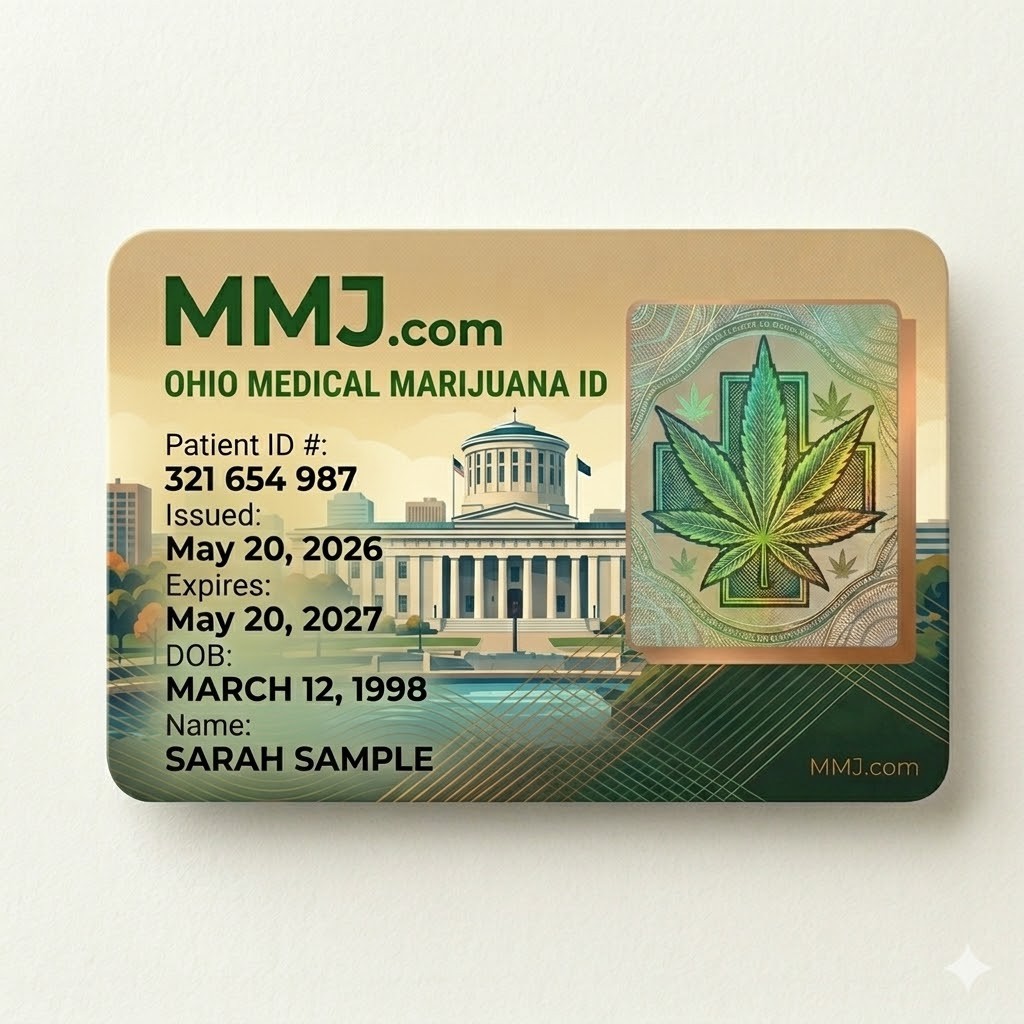
  4. Get your card. Ohio processes applications quickly, typically within one to two business days. You will receive a patient registry ID number that allows immediate dispensary access, plus the ability to print a temporary card while your physical card arrives by mail.

The total cost through MMJ.com is $149.99 for the physician evaluation, and the state charges essentially nothing for registration. If you are not approved, MMJ.com provides a full refund, no questions asked.

Ohio recognizes 26 qualifying conditions, and chronic pain alone covers a wide range of symptoms and diagnoses. If you are unsure whether you qualify, our compassionate physicians can help assess your situation.

Ready to get started? Schedule your Ohio medical marijuana evaluation today.

Frequently Asked Questions

Can I use telemedicine for my Ohio medical marijuana evaluation? Yes. Ohio permits telehealth evaluations for medical marijuana certification. You can complete your entire evaluation via video call or phone call from home. MMJ.com offers same-day telehealth appointments.

How much does an Ohio medical marijuana card cost? The physician evaluation through MMJ.com is $149.99, and Ohio's state registration fee is just one cent. There are no hidden fees.

How long is an Ohio medical marijuana certification valid? Ohio physician certifications are valid for 90 days, requiring four recertification appointments per year. The state registration itself does not expire with your certification.

Does Ohio accept out-of-state medical marijuana cards? No. Ohio has no reciprocity program. You must be an Ohio resident with a valid Ohio registration to purchase from Ohio dispensaries.

Can I grow my own cannabis with a medical card? Under Issue 2, adults may cultivate up to 6 plants per person (12 per household). SB 56 added restrictions on where you can grow but did not eliminate home cultivation. A medical card is not required for home growing, but it does provide additional legal protections.

Why should I get a medical card if recreational is legal? Medical registration saves you 10% on every purchase through the excise tax exemption, gives you higher possession limits, allows access at age 18, and provides priority service at many dispensaries. For regular consumers, the tax savings alone easily pay for the cost of the card.

MMJ.com is Ohio's trusted medical marijuana certification provider. We have helped thousands of patients access medical cannabis through our convenient telehealth platform. Schedule your evaluation today and start saving at the dispensary.

Sources and References

  • Ohio Legislature, House Bill 523, 131st General Assembly
  • Ohio Division of Cannabis Control (com.ohio.gov)
  • Ohio State Medical Board, Qualifying Conditions and CTR Program
  • Marijuana Policy Project, Ohio Medical Marijuana Law Summary (mpp.org)
  • Ohio State University Drug Enforcement and Policy Center, OMMCP Annual Survey (2025)
  • Ohio Legislature, Senate Bill 56, 136th General Assembly
  • Ballotpedia, Ohio Issue 2, Marijuana Legalization Initiative (2023)
  • Ohio Capital Journal, "Ohio's medical marijuana program saw a 43% decline in active patients" (October 2025)
  • Cannabis Science and Technology, "Ohio Cannabis Sales Surpass $3 Billion" (2025)

About the Author

This article was written by the MMJ.com Medical Team, a group of licensed healthcare professionals specializing in medical cannabis certification. Our team has helped over 10,000 patients obtain their medical marijuana cards.

Found this helpful? Share it!

Share:

Get your medical marijuana card online

MMJ.com connects patients with licensed physicians for fast, legal medical cannabis evaluations. See if you qualify in minutes.

See if you qualify