
Virginia MMJ Card Renewal: Complete Guide
Why the Virginia Medical Cannabis Program Is Structurally Unique
Virginia operates a medical cannabis program structurally different from almost every other state. Three features set Virginia apart:
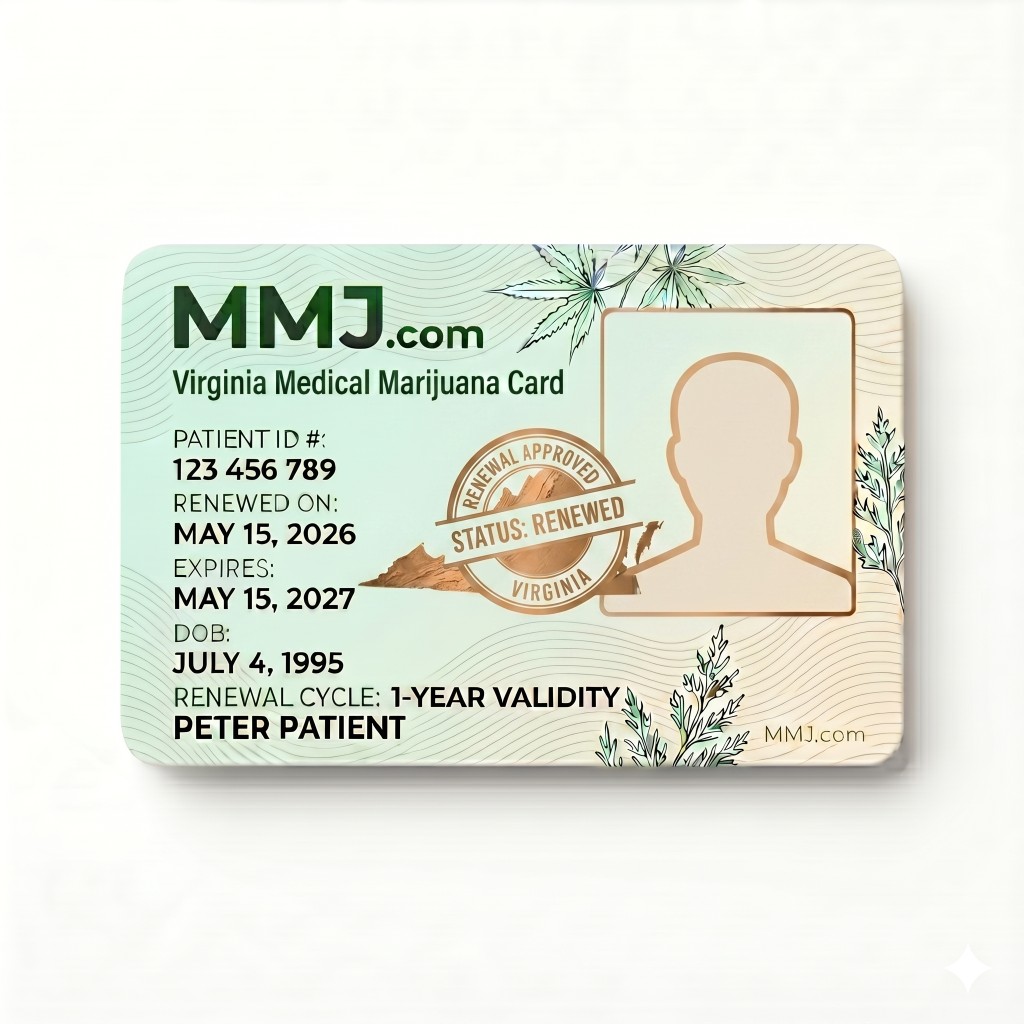
- CARDLESS certification-based system. Virginia eliminated the patient registration requirement under HB 933 of 2022 (effective July 1, 2022). There is NO required state-level patient fee and NO separate registry submission step. Since December 1, 2025, practitioners issue every new or renewed Written Certification through the Cannabis Control Authority's CCA Portal (paper certification forms were retired), and the portal generates a digital Certification Identification Card the patient can store on a phone or print. That digital credential plus a government ID is all that is required for dispensary access.
- Adult-use retail is enacted but not yet open. Virginia legalized adult-use cannabis possession in 2021 under HB 2312 of 2021 (1 oz public possession, 4 plants per household for adults 21-plus, effective July 1, 2021). After retail-sales bills were vetoed in 2024 and 2025, the General Assembly enacted a full adult-use retail framework inside the HB 30 biennial budget on June 29, 2026. Retail sales begin July 1, 2027. Until then, the medical pharmaceutical processor system is the ONLY legal retail pathway in Virginia.
- No cannabis excise tax on medical purchases. Medical cannabis purchases carry only Virginia's ordinary retail sales tax (5.3 percent state plus a small local portion, roughly 6 percent total at the register). There is no cannabis-specific excise tax on medical purchases, and HB 30 expressly excludes medical sales from the new state cannabis tax (6 percent at launch, rising to 8 percent on July 1, 2029) and the mandatory 1 to 3.5 percent local cannabis tax that adult-use purchases will carry.
Together, these features mean a Virginia medical cannabis renewal is one of the simplest and lowest-cost annual processes in the country: $149.99 for the practitioner evaluation, no required state fee, no card-mailing step, and no registry submission.
Virginia CCA Renewal: Quick Facts
- Regulator: Virginia Cannabis Control Authority (CCA)
- Statute (program): Title 4.1 of the Code of Virginia (the Cannabis Control Act, established under HB 2312 of 2021); Va. Code § 4.1-1601 et seq. (pharmaceutical processors and cannabis dispensing)
- Statute (cardless reform): HB 933 of 2022 (effective July 1, 2022, eliminated the patient registration requirement)
- Statute (adult-use possession): HB 2312 of 2021 (legalized 1 oz public possession for adults 21-plus, effective July 1, 2021)
- Statute (adult-use retail): HB 30 biennial budget (enacted June 29, 2026); CCA regulations due February 1, 2027; retail sales begin July 1, 2027
- Adult-use retail status: Enacted but not yet open (sales begin July 1, 2027; until then the medical pharmaceutical processor system is the only legal retail pathway)
- Card validity: Up to 1 year (the Written Certification, not a card; the practitioner may set an earlier expiration)
- MMJ.com practitioner fee: $149.99 (renewal-priced video evaluation)
- Required state fee: $0 (Virginia is cardless under HB 933 of 2022)
- Optional CCA Patient Portal registration card: $50 (NOT required for dispensary access; most patients skip it)
- Total renewal cost: $149.99
- Patient registration: ELIMINATED as a requirement under HB 933 of 2022 (effective July 1, 2022); a voluntary $50 registration remains available (mainly used to add a registered agent not named on the certification)
- Patient ID card: No mailed state card (cardless system; the CCA Portal generates a free digital Certification Identification Card, presented with a government ID for dispensary access)
- Certification issuance: Paperless since December 1, 2025 (practitioners issue all Written Certifications through the CCA Portal)
- Qualifying conditions: Open framework (any condition for which the practitioner determines medical cannabis is appropriate; one of the most permissive standards in the country)
- Telehealth allowed for renewals: Yes, audio-visual video evaluation
- Practitioner requirement: Virginia-licensed practitioner of medicine or osteopathy, physician assistant, or advanced practice registered nurse
- Tax at the register (medical): Ordinary retail sales tax only (5.3% state plus local portion, roughly 6% total); no cannabis-specific excise tax on medical purchases
- Tax adult-use retail will carry (from July 1, 2027): The same sales tax PLUS a 6% state cannabis tax (8% from July 1, 2029) PLUS a mandatory 1 to 3.5% local cannabis tax; HB 30 expressly excludes medical sales from the cannabis tax
Your Virginia CCA Renewal Process
The renewal is fully online for returning Virginia patients. Begin up to 60 days before your annual Written Certification expires.
Step 1: Book Your Renewal Evaluation
Schedule a renewal-priced ($149.99) appointment with a Virginia-licensed practitioner authorized to certify under Virginia law (MD, DO, PA, or APRN) on MMJ.com. The HIPAA-compliant intake captures your existing certification profile (current expiration date, originally-recommending qualifying condition under Virginia's open-framework standard), and a brief update on symptoms and treatment response since your last certification. Returning patients typically book and complete the visit on the same day.
Step 2: Complete the Secure Video Evaluation
Connect via audio-visual video telehealth for a 10 to 15 minute renewal evaluation. The Virginia-licensed practitioner verifies your qualifying condition is still present, reviews any treatment changes since the last certification, confirms continued clinical appropriateness of medical cannabis under Virginia's open-framework standard, and digitally signs the Written Certification. MMJ.com routes Virginia renewals only to practitioners authorized to certify under Title 4.1 of the Code of Virginia (a physician of medicine or osteopathy, a physician assistant, or an advanced practice registered nurse) who issue certifications through the CCA Portal. MMJ.com refunds the $149.99 in full if you are clinically ineligible per the 100% money-back guarantee.
Step 3: Receive Your Written Certification Through the CCA Portal (CARDLESS)
Since December 1, 2025, your practitioner issues the Written Certification directly in the Cannabis Control Authority's CCA Portal (paper certification forms were retired). The portal generates a digital Certification Identification Card that you can access from any phone, tablet, or computer, print if you prefer a paper copy, or store on your device. Critically, Virginia is a CARDLESS state under HB 933 of 2022 (effective July 1, 2022, which eliminated the patient registration requirement). The digital certification plus a government ID (Virginia DL, Virginia state ID, or any U.S. government-issued photo ID) is all that is required for dispensary access. There is no mailed patient ID card, no required state-level patient registration fee, and no separate registry submission step.
Step 4: Optional - The $50 Voluntary CCA Registration
Virginia still offers a voluntary patient registration through the CCA ($50 initial, $50 annual renewal under 3VAC10-20-20), but it is NOT required for dispensary access. Since the CCA Portal already generates a free digital Certification Identification Card, the voluntary registration today is mainly used to add a registered agent (someone who picks up or receives products on the patient's behalf) when the practitioner did not name one on the Written Certification itself. Most Virginia patients skip this step entirely.
Step 5: Shop at a Licensed Virginia Medical Dispensary
Present your digital Certification Identification Card (on your phone or printed) plus a government ID at any licensed pharmaceutical processor or cannabis dispensing facility in Virginia. The medical system remains the ONLY legal retail pathway in Virginia until adult-use retail sales begin on July 1, 2027 under HB 30. Medical purchases carry only ordinary retail sales tax (roughly 6 percent total at the register) with no cannabis-specific excise tax.
Cost Breakdown: $149.99 Total (Lowest-Cost Annual Renewal in the Country)
| Component | Cost | Paid To |
|---|---|---|
| MMJ.com renewal video evaluation | $149.99 | MMJ.com |
| Required Virginia state-level patient fee | $0.00 | (none, eliminated under HB 933 of 2022) |
| Required patient ID card / mailing | $0.00 | (none, cardless system) |
| Optional CCA Patient Portal registration card | $50.00 | Virginia CCA (NOT required) |
| Total (typical) | $149.99 |
Virginia is structurally one of the lowest-cost annual renewal cycles in the country. Most state programs charge a $50 to $200 state-level patient fee on top of the practitioner evaluation, mail a physical or digital ID card, and may require a separate registry submission step. Virginia eliminated all of those friction points under HB 933 of 2022, leaving only the practitioner evaluation cost ($149.99 on MMJ.com).
The trade-off, if there is one, is that the digital Certification Identification Card must be presented at every dispensary visit (vs. a card patients carry in a wallet). Most Virginia patients save it to their phone or print a copy and present it at the register alongside their government ID; the workflow is comparable to presenting a digital insurance card.
Virginia's Open-Framework Qualifying-Condition Standard
Virginia uses an open-framework qualifying-condition standard, similar to Oklahoma. There is NO enumerated list of qualifying conditions like Pennsylvania's 24-condition list under 35 P.S. § 10231.103 or New Jersey's 17-condition list under N.J.S.A. 24:6I-3. Instead, a Virginia-licensed practitioner (MD, DO, PA, or APRN) may issue a Written Certification for any condition they determine medical cannabis is appropriate to treat, based on standard medical practice.
Common conditions cited in Virginia Written Certifications include chronic pain, anxiety, post-traumatic stress disorder (PTSD), inflammatory bowel disease, multiple sclerosis, cancer, HIV / AIDS, opioid use disorder, neuropathy, severe nausea, severe muscle spasms, fibromyalgia, ADHD, autism spectrum disorder, and any condition for which conventional medications have been ineffective or have caused intolerable side effects. The renewal evaluation simply verifies the originally-recommending condition is still present (or that a different qualifying condition has emerged since the last certification).
Why the Medical Card Still Matters in Virginia (Despite Legal Adult-Use Possession)
Virginia is in a transition period: legal adult-use possession today, and an enacted adult-use retail market that does not open until July 1, 2027. This makes the medical Written Certification critically important for patients who want legal access to retail cannabis products in the state:
- No adult-use retail until July 1, 2027. The HB 30 budget enacted the retail framework on June 29, 2026, but sales do not begin until July 1, 2027. Until then, the medical pharmaceutical processor system is the ONLY legal retail pathway. Without a Written Certification, an adult must either grow their own cannabis (4-plant household limit under HB 2312 of 2021) or possess what was given to them legally without payment.
- Medical purchases skip the cannabis tax permanently. HB 30 expressly excludes medical sales from the new state cannabis tax. When adult-use retail opens, adult-use buyers will pay a 6 percent state cannabis tax (rising to 8 percent on July 1, 2029) PLUS a mandatory 1 to 3.5 percent local cannabis tax PLUS the ordinary retail sales tax. Medical patients pay only the ordinary retail sales tax (roughly 6 percent total), a savings of 7 to 11.5 percentage points on every purchase once the adult-use market opens.
- No legal alternative for ages 18-20. Adult-use possession under HB 2312 of 2021 is restricted to ages 21-plus. Patients aged 18 to 20 who qualify for medical cannabis must maintain an active Written Certification to legally possess cannabis in Virginia.
- Cardless renewal is the lowest-cost annual cycle. At $149.99 total (no state fee), the Virginia annual renewal is one of the cheapest in the country.
For these reasons, even after adult-use retail launches in July 2027, the medical Written Certification remains the financially superior option for any patient with a qualifying condition.
Common Renewal Mistakes (and How to Avoid Them)
- Expecting a mailed patient ID card. Virginia eliminated the patient registration requirement under HB 933 of 2022 (effective July 1, 2022). The state does not mail a patient ID card. Your credential is the digital Certification Identification Card the CCA Portal generates when the practitioner issues the Written Certification; present it with a government ID. Do not wait for a card in the mail; it will never arrive.
- Confusing the optional $50 registration with a required state fee. The voluntary CCA registration ($50) is OPTIONAL and is NOT required for dispensary access; today it is mainly used to add a registered agent not named on the certification. Most Virginia patients skip it and use the digital certification + government ID at the register instead.
- Letting the Written Certification lapse. The Written Certification is valid for up to 1 year from issuance (the practitioner may set an earlier expiration). Once it expires, you cannot legally purchase from any licensed Virginia dispensary until the renewal evaluation is completed. There is no adult-use retail fallback until sales begin July 1, 2027.
- Using an ineligible practitioner. Title 4.1 of the Code of Virginia and Va. Code § 4.1-1601 et seq. limit Written Certifications to a Virginia-licensed practitioner of medicine or osteopathy, a physician assistant licensed by the Board of Medicine, or an advanced practice registered nurse. MMJ.com routes Virginia renewals only to practitioners authorized to certify under Virginia law who issue certifications through the CCA Portal.
- Arriving at the dispensary without your certification. Save the digital Certification Identification Card to your phone or print a copy before visiting the dispensary. Some dispensaries can look up the certification in their system, but the patient is responsible for presenting it at the register.
- Confusing federal hemp products with CCA-licensed pharmaceutical processor products. Hemp-derived products with delta-8 / delta-9 THC sold at Virginia smoke shops under the federal hemp framework (the 2018 Farm Bill) are NOT regulated by the Virginia CCA medical cannabis program. Only products from licensed pharmaceutical processors and cannabis dispensing facilities qualify as Virginia medical cannabis.
Verified Virginia Renewal Resources
- Virginia Cannabis Control Authority (CCA) - the official CCA homepage with the medical cannabis program information, the registered practitioner roster, the licensed pharmaceutical processor list, and the linked CCA Patient Portal.
- Title 4.1 of the Code of Virginia (Cannabis Control Act) - the statutory framework governing the Cannabis Control Authority, the medical cannabis program, the pharmaceutical processor licensing system, and the adult-use possession framework (the latter under HB 2312 of 2021).
- Va. Code § 4.1-1601 et seq. (Pharmaceutical Processors) - the chapter governing pharmaceutical processor licensing, dispensing, and the practitioner Written Certification framework.
- HB 933 of 2022 (Cardless Patient Reform) - the legislation that eliminated the patient registration requirement effective July 1, 2022, establishing Virginia's cardless certification-based medical cannabis system.
- HB 2312 of 2021 (Cannabis Control Act / Adult-Use Possession) - the legislation that created the Virginia Cannabis Control Authority, legalized adult-use possession, and reorganized the medical cannabis program under Title 4.1 of the Code of Virginia.
- CCA Portal announcement (paperless certifications) - the CCA's notice that all Written Certifications are issued through the CCA Portal beginning December 1, 2025.
Sources: Virginia Cannabis Control Authority (CCA), Title 4.1 of the Code of Virginia (Cannabis Control Act, established under HB 2312 of 2021), Va. Code § 4.1-1601 et seq. (pharmaceutical processors and cannabis dispensing), HB 933 of 2022 (cardless patient reform, effective July 1, 2022), 3VAC10-20-20 (voluntary registration fees), the CCA's December 1, 2025 paperless certification transition, and the HB 30 biennial budget (enacted June 29, 2026; adult-use retail framework with sales beginning July 1, 2027 and medical sales excluded from the state cannabis tax).