Texas MMJ Card Renewal: Complete Guide
Why the Texas CUP Is Different From Every Other State Program
Texas operates a low-THC prescription program, NOT a traditional medical marijuana card program. The Texas Compassionate Use Program (CUP), administered by the Texas Department of Public Safety (DPS) under Texas Health and Safety Code Chapter 487 (the Texas Compassionate-Use Act, originally SB 339 of 2015), is structurally unique among the 38+ U.S. state medical cannabis programs:
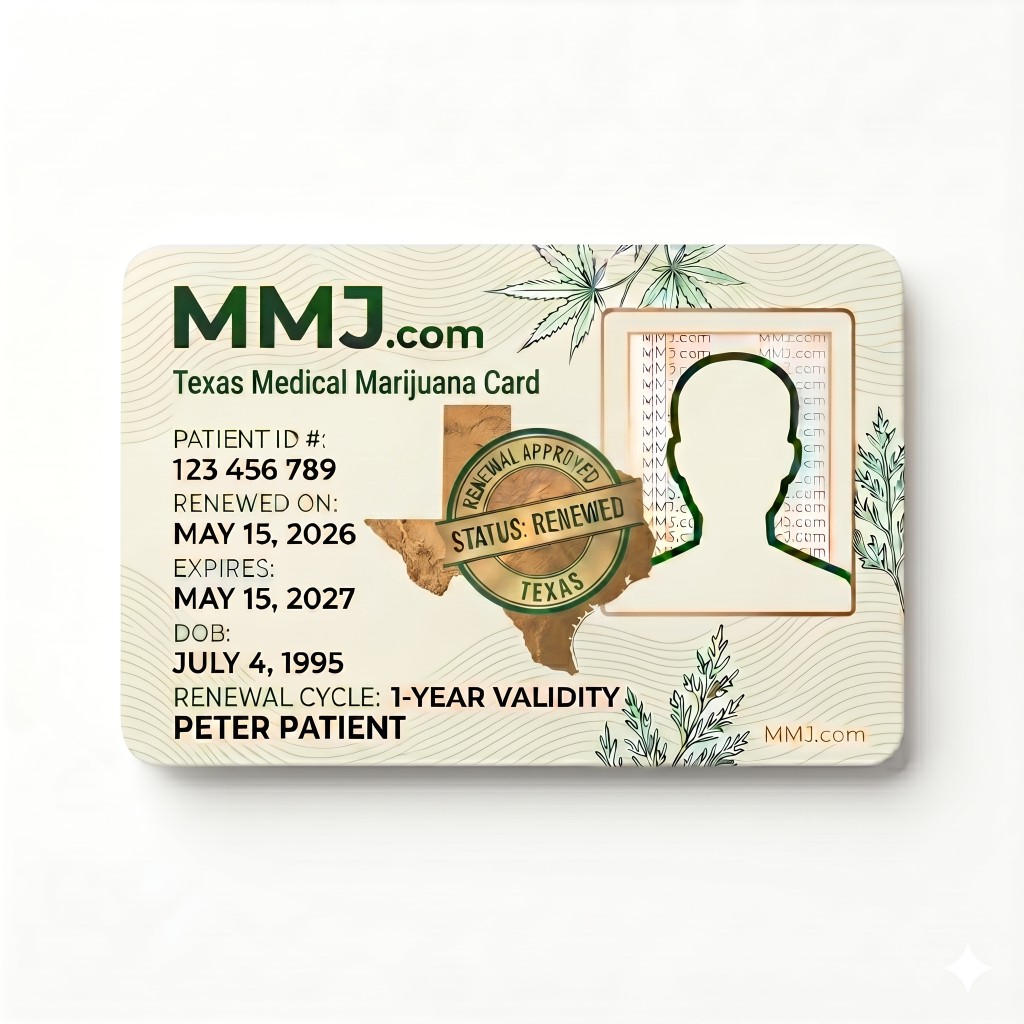
- NO patient ID card. Texas does not issue a physical or digital patient ID card. The Compassionate Use Registry of Texas (CURT), maintained by DPS, stores the prescription electronically; identity is verified at the dispensing organization against CURT using the patient's Texas DL or state ID.
- NO state-level patient enrollment fee. Texas is one of only a handful of state programs with a $0 patient fee. The only cost to the patient is the physician evaluation ($149.99 on MMJ.com) and the products themselves.
- NO paper prescription. The physician electronically enters the low-THC cannabis prescription directly into CURT under Texas Occupations Code § 169. The CURT entry IS the prescription; patients do not receive a paper Rx, and dispensing organizations do not accept one.
- Low-THC framework, NOT full medical marijuana. Products dispensed under the Texas CUP are dosage-capped at 10 mg THC per dosage unit with a maximum of 1 gram (1,000 mg) of total THC per package under HB 46 of 2025, effective September 1, 2025 (replacing the old 1 percent by weight cap from HB 1535 of 2021). Smokable flower remains prohibited, though HB 46 added pulmonary inhalation (prescribed aerosol and vapor devices) as a permitted administration method.
- Physician must be specifically registered with CURT. Under Texas Occupations Code § 169.002 and § 169.003, only Texas-licensed physicians who are specifically registered with the Compassionate Use Registry of Texas may issue low-THC cannabis prescriptions. General TX physician licensure alone is insufficient.
- NO adult-use market. Texas has no adult-use (recreational) cannabis program; CBD and hemp-derived products with low THC are sold under the federal hemp framework, but those are NOT regulated as medical cannabis.
The "renewal" on this page is a re-prescription via CURT, not a card renewal. Under HB 46, each prescription covers up to a 90-day supply with up to four refills, and the renewal cycle is structurally similar to other states (book a renewal evaluation, complete a video visit, the physician files to the state registry), but the absence of a card, a state fee, and a paper Rx means the process is faster and lower-cost than most state programs.
Texas CUP Renewal: Quick Facts
- Regulator: Texas Department of Public Safety (DPS)
- State registry: Compassionate Use Registry of Texas (CURT)
- Statute (program): Texas Health and Safety Code Chapter 487 (Texas Compassionate-Use Act / SB 339 of 2015)
- Statute (physician registration): Texas Occupations Code § 169 (§ 169.002, 169.003, 169.004)
- Statute (qualifying conditions): Texas Health and Safety Code § 487.052
- Recent expansions: HB 3703 of 2019 (added MS, ALS, autism, terminal cancer, all forms of seizures), HB 1535 of 2021 (raised the old weight-based THC cap to 1%, added all cancers and all PTSD), and HB 46 of 2025 (effective September 1, 2025: replaced the weight cap with a 10 mg per-dose / 1 gram per-package dosage cap, added chronic pain, TBI, Crohn's / IBD, and hospice / palliative care, authorized pulmonary inhalation, and expanded licensing from 3 to 15 dispensing organizations)
- THC cap: 10 mg THC per dosage unit; maximum 1 gram (1,000 mg) total THC per package (under HB 46 of 2025)
- Adult-use status: NOT legal
- Patient ID card: NONE (CURT registry only)
- Paper prescription: NONE (CURT entry IS the prescription)
- Identity verification at point of sale: Texas DL or state ID matched against CURT database
- Prescription validity: each prescription covers up to a 90-day supply with up to four refills under HB 46; your physician determines when a re-evaluation is required
- MMJ.com physician fee: $149.99 (renewal-priced video evaluation)
- State-level patient fee: $0 (Texas is one of only a handful of state programs with a $0 patient fee)
- Total renewal cost: $149.99
- Qualifying conditions: epilepsy / seizure disorders, multiple sclerosis (MS), spasticity, amyotrophic lateral sclerosis (ALS), autism spectrum disorder, all cancers (per HB 1535 of 2021), post-traumatic stress disorder (per HB 1535 of 2021), chronic pain associated with an underlying chronic condition (per HB 46 of 2025), traumatic brain injury (per HB 46 of 2025), Crohn's disease and other inflammatory bowel disease (per HB 46 of 2025), terminal illness or hospice / palliative care (per HB 46 of 2025), and incurable neurodegenerative diseases (Parkinson's, Alzheimer's, Huntington's, dementia)
- Telehealth allowed for renewals: Yes, audio-visual video evaluation
- Physician requirement: Texas-licensed physician AND specifically registered with CURT under Texas Occupations Code § 169
- Licensed dispensing organizations: 3 active statewide (Fluent, Texas Original, Goodblend), all licensed under Texas Health and Safety Code Chapter 487; 12 additional conditional licensees are completing DPS review under HB 46's 15-license expansion
- Statewide delivery: Yes, the active dispensing organizations deliver low-THC products statewide via state-compliant courier to any Texas address; HB 46 also authorized satellite locations
- State sales tax (medical): Standard 6.25 percent state sales tax applies (Texas does NOT exempt low-THC cannabis from sales tax)
- Local sales tax: Typically 1 to 2 percent depending on county and municipality
Your Texas CUP Renewal Process
The renewal is fully online for returning Texas patients. Begin up to 60 days before your prescription and its refills run out so dispensary access never lapses.
Step 1: Book Your Renewal Evaluation
Schedule a renewal-priced ($149.99) appointment with a Texas-licensed physician registered with the Compassionate Use Registry of Texas (CURT) under Texas Occupations Code § 169 on MMJ.com. The HIPAA-compliant intake captures your existing CURT prescription profile (current Rx expiration date, prescribing physician), the originally-recommending qualifying condition under Texas Health and Safety Code § 487.052 (one of the enumerated conditions including epilepsy / seizure disorders, multiple sclerosis, spasticity, ALS, autism spectrum disorder, all cancers per HB 1535 of 2021, PTSD per HB 1535 of 2021, chronic pain, TBI, Crohn's / IBD, or hospice / palliative care per HB 46 of 2025, or incurable neurodegenerative diseases), and a brief update on symptoms and treatment response since your last prescription.
Step 2: Complete the Secure Video Evaluation
Connect via audio-visual video telehealth for a 10 to 15 minute renewal evaluation. The CURT-registered physician verifies your qualifying condition is still present, reviews any treatment changes since the last prescription, confirms continued clinical appropriateness of low-THC cannabis (dosage-capped at 10 mg THC per dose and 1 gram total THC per package under HB 46 of 2025), and prepares the new electronic prescription. MMJ.com routes Texas renewals only to physicians actively licensed by the Texas Medical Board AND specifically registered with the Compassionate Use Registry of Texas under Tex. Occ. Code § 169 (general TX physician licensure alone is insufficient, the physician must be CURT-registered). MMJ.com refunds the $149.99 in full if you are clinically ineligible per the 100% money-back guarantee.
Step 3: Physician Electronically Files the New Prescription to CURT
Your physician electronically enters the new low-THC cannabis prescription directly into the Compassionate Use Registry of Texas (CURT) maintained by the Texas DPS under Texas Health and Safety Code Chapter 487. No paper prescription is issued and Texas does not issue patient ID cards; the CURT entry IS the prescription. Identity is verified at the dispensing organization against the CURT database using your Texas DL or state ID at the point of sale, so do not expect a card or paper Rx in the mail.
Step 4: Confirm the Prescription Is Active in CURT (No State Fee)
There is NO state-level patient enrollment fee in Texas; the CUP is one of the only state medical cannabis programs with a $0 patient fee. The only cost is the $149.99 MMJ.com physician evaluation. The new prescription is typically active in CURT within minutes of the physician submission, and you can confirm activation by contacting any active DPS-licensed dispensing organization and providing your Texas DL or state ID for a CURT lookup. The new prescription replaces the prior expiring entry in your CURT profile.
Step 5: Order from a DPS-Licensed Dispensing Organization (Statewide Delivery)
Three active DPS-licensed dispensing organizations operate statewide under Texas Health and Safety Code Chapter 487:
- Fluent (formerly Cansortium Texas) - statewide-courier delivery
- Texas Original (Austin; the registered entity is Texas Original Compassionate Cultivation) - statewide-courier delivery
- Goodblend (Austin) - statewide-courier delivery
Under HB 46 of 2025, DPS is expanding the program from 3 to 15 total licenses; 12 conditional licensees selected in Phase I (December 2025) and Phase II (2026) are completing DPS review before they begin dispensing, and HB 46 also authorizes satellite locations. All active organizations deliver low-THC cannabis products statewide via state-compliant courier to any Texas address (Houston, Dallas / Fort Worth, San Antonio, El Paso, Lubbock, Amarillo, Corpus Christi, McAllen, and rural counties), so patients do not need to travel to Austin. Product types include tinctures, gummies, lozenges, capsules, topicals, and prescribed pulmonary-inhalation devices (added by HB 46; smoking remains prohibited); products are dosage-capped at 10 mg THC per dose and 1 gram total THC per package. Standard Texas sales tax of 6.25 percent state plus 1 to 2 percent local sales tax applies (Texas does not exempt low-THC cannabis from sales tax).
Cost Breakdown: $149.99 Total (Lowest of Any State)
| Component | Cost | Paid To |
|---|---|---|
| MMJ.com renewal video evaluation | $149.99 | MMJ.com |
| Texas DPS / CURT state-level patient fee | $0.00 | (none) |
| Paper prescription / card mailing | $0.00 | (none) |
| Total | $149.99 |
Texas is structurally different from every other state in cost. Most state programs charge a $50 to $200 state-level patient enrollment fee on top of the physician evaluation; Texas charges $0. The only cost to the patient is the $149.99 MMJ.com physician evaluation. Patients who would otherwise pay $250 to $350 annually under other state programs save $100 to $200 per year on the renewal alone in Texas.
The trade-off is the low-THC framework: products are dosage-capped at 10 mg THC per dose and 1 gram of total THC per package under HB 46 of 2025, with no smokable flower (prescribed pulmonary-inhalation devices are permitted). For patients whose conditions respond to precisely dosed, lower-THC formulations (epilepsy, autism spectrum disorder, neurodegenerative diseases, chronic pain managed with measured dosing), the Texas CUP is well-matched; patients accustomed to high-THC flower and concentrate menus in full medical marijuana states will find the Texas formulary more restrictive.
Texas CUP Qualifying Conditions Under Tex. Health & Safety Code § 487.052
The current list of qualifying conditions under Texas Health and Safety Code § 487.052 includes (as expanded by HB 3703 of 2019, HB 1535 of 2021, and HB 46 of 2025):
- Epilepsy and other seizure disorders (the original SB 339 of 2015 only covered "intractable epilepsy"; HB 3703 of 2019 expanded to all forms)
- Multiple sclerosis (MS)
- Spasticity
- Amyotrophic lateral sclerosis (ALS)
- Autism spectrum disorder (added under HB 3703 of 2019)
- All cancers (HB 1535 of 2021 expanded from terminal-cancer-only to all cancers at any stage)
- Post-traumatic stress disorder (PTSD) (added under HB 1535 of 2021; covers all PTSD, not just combat-related)
- Chronic pain associated with an underlying chronic condition (added under HB 46 of 2025, effective September 1, 2025)
- Traumatic brain injury (TBI) (added under HB 46 of 2025)
- Crohn's disease and other inflammatory bowel disease (IBD) (added under HB 46 of 2025)
- Terminal illness or a condition for which the patient is receiving hospice or palliative care (added under HB 46 of 2025)
- Incurable neurodegenerative diseases (Parkinson's, Alzheimer's, Huntington's, dementia, and similar conditions)
The renewal evaluation simply verifies the originally-prescribing condition is still present. Physicians may also re-evaluate whether a different qualifying condition has emerged since the last prescription (for example, a patient originally prescribed for epilepsy who has since been diagnosed with MS).
Common Renewal Mistakes (and How to Avoid Them)
- Expecting a physical card. Texas does NOT issue patient ID cards. The CURT entry IS the prescription, and identity is verified at the dispensing organization using your Texas DL or state ID. Do not wait for a card in the mail; it will never arrive.
- Expecting a paper prescription. Texas physicians do NOT write paper Rx for low-THC cannabis under the CUP. The prescription is electronic only, entered directly into CURT.
- Using a non-CURT-registered physician. Tex. Occ. Code § 169.002 requires the physician be specifically registered with the Compassionate Use Registry of Texas. Most general TX physicians are NOT CURT-registered. MMJ.com routes Texas renewals only to physicians actively licensed by the Texas Medical Board AND CURT-registered.
- Letting the prescription lapse. Once your prescription and its refills are exhausted or expired, you cannot purchase from any DPS-licensed dispensing organization until the renewal evaluation is completed and the new prescription is entered into CURT. Book the MMJ.com renewal evaluation at least 30 days before your prior prescription expires.
- Confusing hemp / CBD products with CUP-licensed products. Hemp-derived products with delta-8 / delta-9 THC sold at Texas smoke shops under the federal hemp framework are NOT regulated by the Texas CUP and do NOT count as your medical cannabis prescription. Only low-THC products from DPS-licensed dispensing organizations (currently Fluent, Texas Original, and Goodblend) qualify.
- Trying to fill the prescription out of state. The CURT prescription is only valid at DPS-licensed dispensing organizations within Texas. Texas does NOT have medical reciprocity with any other state, and no out-of-state dispensary accepts a CURT prescription.
Verified Texas CUP Resources
- Texas Department of Public Safety - Compassionate Use Program - the official Texas DPS CUP homepage with the patient information, the dispensing organization licensee list, the physician registration instructions, and the linked CURT system access for registered physicians.
- Texas Health and Safety Code Chapter 487 (Texas Compassionate-Use Act) - the statutory framework governing the Texas Compassionate Use Program, originally enacted as SB 339 of 2015 and expanded by HB 3703 of 2019, HB 1535 of 2021, and HB 46 of 2025.
- Texas Occupations Code § 169 (Authority to Prescribe Low-THC Cannabis) - the statutory framework governing physician registration with the Compassionate Use Registry of Texas (CURT), including § 169.002 (registration requirements), § 169.003 (prescription standards), and § 169.004 (compliance and reporting).
- DPS 89th Legislation Summary (HB 46 of 2025) - the official DPS summary of HB 46, effective September 1, 2025: the 10 mg per-dose / 1 gram per-package dosage cap, the new qualifying conditions (chronic pain, TBI, Crohn's / IBD, hospice / palliative care), pulmonary inhalation, satellite locations, and the expansion from 3 to 15 dispensing-organization licenses.
- HB 1535 of 2021 (Texas 87th Legislature) - the earlier legislation that raised the legacy weight-based THC cap from 0.5 percent to 1 percent, expanded qualifying conditions to include all cancers (not just terminal), and added all forms of post-traumatic stress disorder (not just combat-related).
Content verified August 2026. Sources: Texas Department of Public Safety - Compassionate Use Program, Texas Health and Safety Code Chapter 487 (Texas Compassionate-Use Act, originally SB 339 of 2015), Texas Occupations Code § 169 (physician registration with CURT), HB 3703 of 2019 (initial qualifying-condition expansion), HB 1535 of 2021 (weight cap raised to 1%, added all cancers and all PTSD), HB 46 of 2025 (10 mg per-dose / 1 g per-package dosage cap, new qualifying conditions, 15-license expansion, effective September 1, 2025), and the Compassionate Use Registry of Texas (CURT) maintained by Texas DPS.