Written by
John ProgarOhio Senate Bill 56 is no longer pending, no longer theoretical, and no longer stoppable. The law took effect on Friday, March 20, 2026, after a referendum effort by Ohioans for Cannabis Choice failed to collect enough signatures by the March 19 deadline and a last-minute lawsuit in Franklin County Court of Common Pleas was denied the day before implementation.
What voters approved in 2023 with 57% support through Issue 2 has been substantially rewritten by the Ohio General Assembly. The core right to possess and use cannabis remains, but nearly every surrounding rule has been tightened. Some changes were expected. Others are catching Ohio residents off guard.
Here is everything that changed on March 20, and what it means for patients, recreational consumers, and the 6,000 hemp businesses affected.
Possession: Same Limits, New Criminal Exposure
The headline numbers are unchanged. Adults 21 and older can still possess up to 2.5 ounces of cannabis flower and 15 grams of concentrates.
But SB 56 added a requirement that no other legalization state imposes: mandatory Ohio-only sourcing. Your cannabis must come exclusively from an Ohio-licensed dispensary or legal home cultivation. Possessing marijuana purchased in another state, even from a licensed Michigan dispensary, is now a criminal offense.
As NORML has noted, no other state with legal cannabis imposes this type of sourcing restriction. It effectively transforms the possession limit from a simple weight threshold into a provenance requirement.
Public Consumption: Fully Banned
Under Issue 2, consuming cannabis edibles in public was legal for two years. That is over.
SB 56 criminalizes all forms of public cannabis use, including smoking, vaping, and edibles, as a minor misdemeanor carrying up to a $150 fine. Consumption is only permitted on privately owned property used primarily for residential or agricultural purposes, with the property owner's permission.
Landlords can now prohibit both smoking and vaping (previously only smoking) in lease agreements. Violating a lease cannabis prohibition can trigger a misdemeanor charge.
New Transport Rules
These rules are entirely new and carry criminal penalties:
- Cannabis must be stored in the vehicle's trunk, or behind the last upright seat if no trunk exists
- Products must remain in original, unopened dispensary packaging during transport
- If a passenger smokes, combusts, or vaporizes cannabis while the driver is operating the vehicle, the passenger faces a third-degree misdemeanor
- Transporting cannabis across state lines into Ohio is explicitly prohibited
There is no grace period. These rules are enforceable now.
Potency Caps
SB 56 introduced THC potency limits that did not exist under Issue 2:
| Product Type | Recreational Limit | Medical Patient Limit |
|---|---|---|
| Flower | 35% THC | No cap |
| Concentrates | 70% THC (was 90%) | No cap |
| Edibles per serving | 10 mg THC | 55 mg THC |
| Edibles per package | 110 mg THC | 1,500 mg THC |
Medical patients retain access to substantially higher potency products. This is one of the most significant practical advantages of holding an Ohio medical marijuana card under SB 56.
Edible Packaging Requirements
All cannabis edibles must be kept in their original packaging at all times when not actively in use. Possessing marijuana in anything other than its original, unopened packaging is a minor misdemeanor.
Products resembling candy or items attractive to children, including those bearing likenesses of fictional characters, animals, or fruit, are now banned.
The Hemp Product Ban
Perhaps the most economically disruptive provision took effect immediately. SB 56 effectively bans all intoxicating hemp products: delta-8 THC, delta-10, THC-A, and similar hemp-derived cannabinoids. Products containing more than 0.4 mg of total THC per container or synthetic cannabinoids can no longer be sold at gas stations, smoke shops, convenience stores, vape shops, or CBD stores.
The Division of Cannabis Control made clear that these products cannot simply migrate to licensed dispensaries either. Dispensaries are only permitted to sell marijuana from Ohio-licensed cultivators and processors, not hemp products.
Governor DeWine vetoed a provision that would have allowed 5 mg THC beverages to continue being sold at bars and restaurants through December 2026, making the ban immediate.
An estimated 6,000 Ohio businesses face closure or significant revenue loss. Ahmad Khalil, owner of Hippie Hut Smoke Shop, told reporters the bill would put businesses like his "out of business" overnight. Bobby Slattery of Fifty West Brewing Company in Cincinnati said the brewery made approximately $1.5 million in THC beverage sales last year and was on pace for $3 million in 2026 before the veto.
Four Ohio breweries, including Jackie O's Brewery, filed a lawsuit on March 6, 2026, challenging the constitutionality of DeWine's line-item veto.
Home Cultivation: Legal but Stricter
Home growing remains legal at 6 plants per adult and 12 per household, but penalties have stiffened:
- Exceeding plant limits is now classified as "illegal cultivation of marijuana", a more serious charge than the simple possession overage it previously was
- Plants must be at the grower's primary residence, in an enclosed secure area, and not visible from public spaces
- Cultivation is prohibited in halfway homes and recovery houses
- On the positive side, dispensaries may now sell cannabis seeds and clones directly to consumers
What Medical Patients Need to Know
Medical cardholders come out of SB 56 in a significantly stronger position than recreational consumers. The gap between the two has widened:
Retained advantages:
- No 10% excise tax on purchases (saving ~$240/year at $200/month spending)
- Higher edible potency: 55 mg/serving vs. 10 mg for recreational
- No potency cap on flower or concentrates
- Higher daily purchase limits: up to 10 ounces per day (four days' supply at once), updated effective March 24, 2026
- Home delivery eligibility (authorized for medical patients only, DCC finalizing rules)
- Anti-discrimination protections for professional licensing, child custody, organ transplants, and medical procedures retained for cardholders
- Priority dispensary service when supply is limited
New concerns for medical patients:
- The same transport, packaging, and public consumption rules apply equally
- Employer protections have weakened: employees discharged for marijuana use in violation of workplace policy are now "discharged for just cause" and ineligible for unemployment benefits, extended from recreational to cover all marijuana use
- The "known user of marijuana" probable cause provision applies to all cannabis users, including medical patients
The Failed Referendum
Ohioans for Cannabis Choice filed a referendum petition in late December 2025 seeking to put the most restrictive portions of SB 56 before voters on the November 2026 ballot. Ohio Attorney General Dave Yost certified the petition language in February 2026, and the group began collecting the approximately 248,000 valid signatures needed.
They did not reach the threshold by the March 19, 2026 deadline. A last-minute lawsuit in Franklin County Court of Common Pleas seeking to delay SB 56's implementation was denied the day before the law took effect.
The failed referendum means SB 56 stands as enacted, with no voter override on the horizon. The pending brewery lawsuit over DeWine's THC beverage veto remains the only active legal challenge.
Dispensary Caps and Licensing Changes
SB 56 imposes a statewide cap of 400 dispensary licenses with:
- A one-mile buffer between dispensaries
- A 500-foot buffer from schools, playgrounds, churches, and public libraries
- No individual or entity may hold more than 8 dispensary licenses, 1 cultivator license, and 1 processor license
Level III cultivator licenses (the smaller-scale licenses created by Issue 2 with social equity preferences) have been eliminated entirely. The Cannabis Social Equity and Jobs Program has been repealed. The 36% of excise tax revenue that Issue 2 directed to this program now goes to municipalities hosting dispensaries, and the remaining 64% goes to the state general fund.
On the positive side, SB 56 creates an expungement pathway for prior marijuana possession convictions involving amounts now legal.
The Political Divide
SB 56 passed with exclusively Republican support: 86-8 in the House and 22-7 in the final Senate vote. Every Democrat voted against it.
Sen. Steve Huffman (R-Tipp City), the bill's sponsor, called it protective of children. Governor DeWine called the signing "a major, major victory" for children's safety.
Democrats were direct in opposition. House Minority Leader Dani Isaacsohn (D-Cincinnati) said: "Ohioans deserve a government that honors their vote, not one that rewrites it." Sen. Bill DeMora asked on the Senate floor: "Can anybody in this room tell me how this is respecting the will of the voters?"
NORML called SB 56 "a re-criminalization bill." The Marijuana Policy Project warned it "would likely result in thousands of cannabis arrests each year."
The Coalition to Regulate Marijuana Like Alcohol, the very group that backed Issue 2, supported SB 56, calling it "a common-sense refinement." This split the cannabis community, with licensed operators generally supporting the bill and hemp businesses, civil liberties groups, and patient advocates opposing it.
Why Your Medical Card Matters More Than Ever
SB 56 has widened the gap between medical and recreational access in Ohio. Every advantage of holding a medical card, from tax savings to potency access to legal protections, is now more significant than it was before March 20.
If you have a qualifying condition and are currently buying recreational, switching to a medical card saves money and provides protections that recreational consumers no longer have.
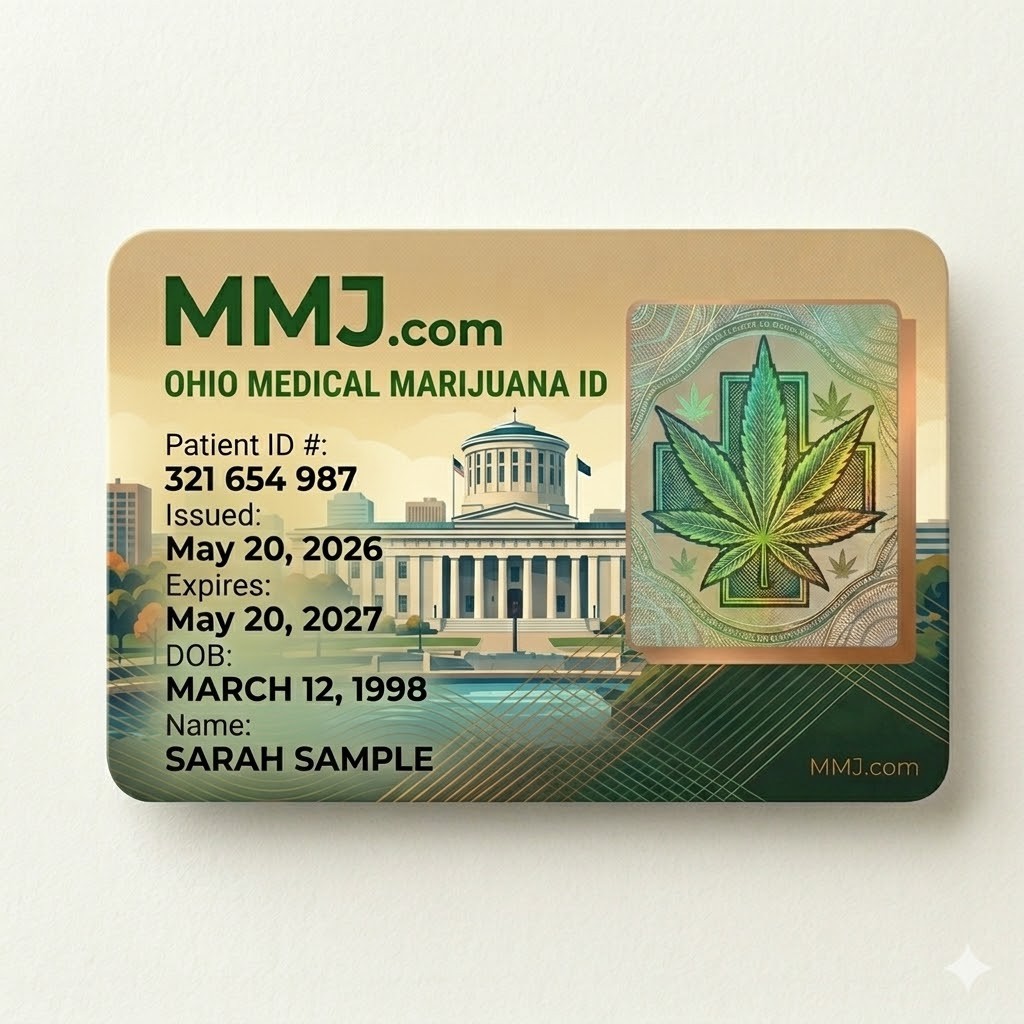
Getting your Ohio medical marijuana card through MMJ.com takes minutes:
- Schedule a same-day telehealth appointment
- Connect with a licensed Ohio physician via phone or video
- Get certified and registered the same day
- Visit any Ohio dispensary and start saving
$149.99 evaluation. 100% money-back guarantee. $0.01 state fee.
Already have a card? Renew your Ohio medical marijuana card before it expires to maintain your protections.
The law the Ohio legislature passed is now the law Ohio residents live under. The transport, packaging, and sourcing rules carry criminal penalties that were not in effect last week. Medical patients retain the strongest legal position. Act accordingly.
Get your Ohio medical marijuana card today.
Sources
- Ohio Legislature, Senate Bill 56, 136th General Assembly
- Governor DeWine signing statement and line-item vetoes, December 19, 2025
- Ohio Division of Cannabis Control, SB 56 Implementation Guidance, March 2026
- Ohio Division of Cannabis Control, Medical Marijuana Daily Purchase Limits Update, effective March 24, 2026
- NORML, "Ohio SB 56: Re-criminalization bill" and Columbus Dispatch op-ed
- Marijuana Policy Project, Ohio SB 56 analysis
- ACLU of Ohio, SB 56 statement
- Coalition to Regulate Marijuana Like Alcohol, SB 56 position statement
- Bloom Dispensary, SB 56 patient guidance
- Ohio Capital Journal, SB 56 coverage, December 2025 and March 2026
- Franklin County Court of Common Pleas, referendum lawsuit denial, March 19, 2026
- Ohio Attorney General Dave Yost, referendum petition certification, February 2026
About the Author
This article was written by the MMJ.com Medical Team, a group of licensed healthcare professionals specializing in medical cannabis certification. Our team has helped over 10,000 patients obtain their medical marijuana cards.