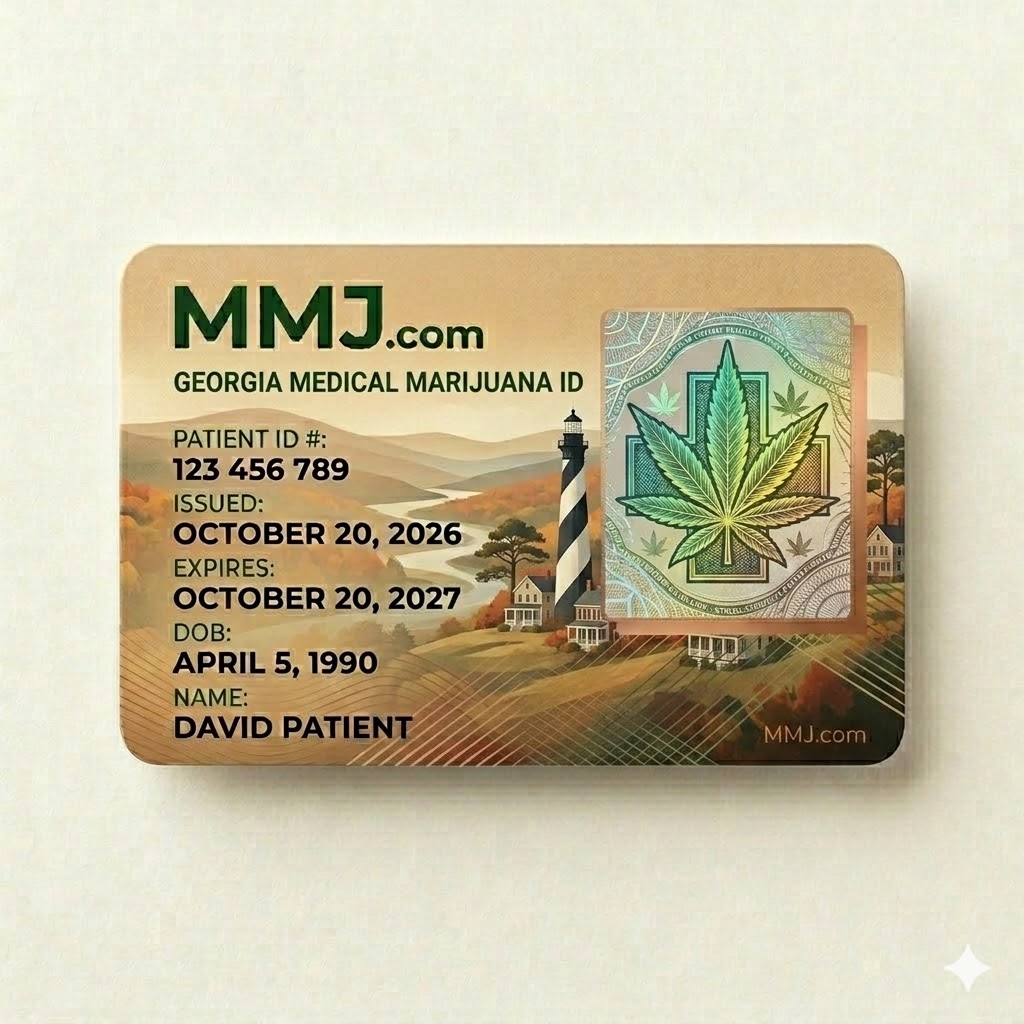
Georgia Medical Marijuana Card: Complete Guide
The 2026 Georgia Medical Cannabis Transition (SB 220)
On May 12, 2026, Governor Brian Kemp signed Senate Bill 220 (The Putting Georgia's Patients First Act). This law fundamentally transforms what was once the nation's most restrictive medical program into a patient-first model effective July 1, 2026.
| Program Feature | Old Georgia Policy (Pre-2026) | New Georgia Policy (Effective July 1, 2026) |
|---|---|---|
| Legal Nomenclature | Low THC Oil Registry | Medical Cannabis Patient Registry |
| THC Potency Cap | Strictly capped at 5% THC by weight (the lowest in the nation); CBD content was required to equal or exceed THC | Potency cap and CBD-balance rule eliminated; products governed by the 1,200 mg per-package THC ceiling only |
| Possession Limit | 20 fluid ounces of low-THC oil | 12,000 mg cumulative THC across all products (1,200 mg max per individual package) |
| Out-of-State Reciprocity | None (possession protection only) | Valid out-of-state medical cards honored for 45 days |
| Over-Limit Penalties | MMJ-specific 20-160 oz felony + 160+/31,000+/154,000+ oz trafficking tiers | Standard O.C.G.A. Title 16 Chapter 13 controlled-substances framework (legacy tiers deleted) |
| Allowable Forms | Tinctures, topicals, capsules, patches (oil-based only) | Oils, tinctures, capsules, patches, lotions at full potency (July 1); vaporization for patients 21+ (vape cartridges, concentrates, and vaporized flower) authorized, phasing in with state ingestion rules due Jan 1, 2027 |
| Smoking / Combustion | ✕ Strictly Prohibited | ✕ Remains Prohibited (vaporization for patients 21+ is a separate, permitted route) |
| Edible Food Products (gummies, cookies, candies) | ✕ Strictly Prohibited | ✕ Remains Prohibited |
| Hemp Products | Regulated separately (HB 213) | Regulated separately (HB 213); not part of the medical cannabis market |
Georgia Medical Cannabis Program Quick Facts
- MMJ.com Evaluation Fee: $149.99
- State Registration Fee: $30.00
- Card Validity Duration: 5 Years (The longest validity term in the US; annual physician recertification required during the 5-year period UNLESS the patient's qualifying condition is incurable or irreversible, see Annual Recertification section below)
- Card Format: Physical, electronic, or both (patient elects under SB 220; electronic cards allow immediate purchase upon receipt, subject to legislative appropriations)
- Telehealth Availability: Permitted; the certifying physician must maintain a principal place of practice in Georgia (SB 220, effective July 1, 2026)
- Total Enrolled Patients (2026): Over 34,500 active cardholders statewide
- Home Cultivation: Strictly Prohibited (Felony)
- Cumulative Possession Cap: 12,000 mg THC across all products (SB 220, July 1, 2026)
- Per-Package Cap: 1,200 mg THC maximum per individual package (SB 220 product definition)
- Out-of-State Recognition: 45 days for visiting patients with a valid home-state medical card (SB 220)
- Public Use: Prohibited under SB 220 (including vaporization); use must occur in a private residence, a private vehicle not in use on a public roadway, or, for institutionally-cared-for patients, within the licensed health care facility
Allowable Medical Cannabis Formulations in Georgia
| Product Type | Status under 2026 Law | Statutory Restrictions |
|---|---|---|
| Liquid Tinctures & Oils | ✓ Allowed | 1,200 mg THC max per individual package; cumulative possession capped at 12,000 mg THC across all products |
| Capsules & Lozenges | ✓ Allowed | Prescribed dosage clearly noted on product label; 1,200 mg THC max per package |
| Topical Creams, Lotions & Patches | ✓ Allowed | Available at all licensed independent pharmacies; 1,200 mg THC max per package |
| Vape Cartridges (21+) | Authorized, pending state rules | New vaporization route under SB 220; phases in as GMCC and DPH issue ingestion rules (due Jan 1, 2027); 1,200 mg THC max per package |
| Concentrates (21+) | Authorized, pending state rules | New vaporization route under SB 220; same ingestion-rule timeline; 1,200 mg THC max per package |
| Vaporized Flower (21+) | Authorized, pending state rules | SB 220 redefines medical cannabis to include the plant, so vaporizing (not smoking) flower is permitted once ingestion rules take effect; 1,200 mg THC max per package |
| Smoking Flower / Pre-rolls | ✕ Prohibited | Smoking and combustion of cannabis remain illegal under SB 220 |
| Edible Food Products (gummies, cookies, candies) | ✕ Prohibited | Food edibles remain strictly illegal; the SB 220 product definition does not authorize them |
What Happens If You Exceed the 12,000 mg Possession Cap?
SB 220 deleted Georgia's legacy MMJ-specific penalty tiers (the old 20 to 160 fluid-ounce felony bracket and the 160+, 31,000+, and 154,000+ fluid-ounce trafficking brackets). Possession of more than the new 12,000 mg cumulative THC limit no longer triggers a medical-marijuana-specific felony. Instead, it falls under Georgia's standard controlled-substances framework under O.C.G.A. Title 16 Chapter 13, the same body of law that governs all non-medical cannabis possession in the state. Always keep the original pharmacy-labeled packaging with your purchase to demonstrate compliance with the per-package and cumulative caps.
Out-of-State Visitors and the 45-Day Recognition Window
SB 220 introduces Georgia's first formal medical cannabis reciprocity: a valid, unexpired medical card issued by another U.S. state is honored at Georgia dispensing pharmacies for 45 days from your first in-state purchase. Visiting patients are bound by the same 12,000 mg cumulative possession cap and 1,200 mg per-package ceiling as Georgia residents. Bring a matching government-issued photo ID along with your home-state card. Out-of-state visitors who plan to remain in Georgia beyond 45 days will need to enroll in the Georgia Medical Cannabis Registry directly through the Department of Public Health.
Where You Can Pick Up Medical Cannabis: Dispensaries vs. Independent Pharmacies
Georgia operates a dual-track dispensing model that is unique in the nation. Standalone medical cannabis dispensaries are licensed by the Georgia Access to Medical Cannabis Commission (GMCC). Independent pharmacies are licensed by the State Board of Pharmacy under the same statute (O.C.G.A. §16-12-206) and may stock and dispense the same SB 220 product set. Georgia became the first state in the nation to allow independent pharmacies to sell medical cannabis when the SBP track went live in 2023, and the network has grown to roughly 56 participating pharmacies alongside the 19 Commission-licensed dispensaries, for approximately 75 total access points statewide.
SB 220's Dry-County Pharmacy Advantage (O.C.G.A. §3-3-21(a)(1))
Effective July 1, 2026, SB 220 prohibits any Commission-issued dispensing license in a location where the retail sale of distilled spirits is prohibited under O.C.G.A. §3-3-21(a)(1). Several Georgia counties and many smaller precincts within otherwise wet counties prohibit distilled-spirits sales by local option, and SB 220 mirrors those boundaries for standalone dispensaries. Pharmacies are expressly exempt: State Board of Pharmacy licenses are excluded from the dry-county restriction, so an SBP-licensed independent pharmacy may continue to dispense medical cannabis in a location where a standalone Commission dispensary cannot. For patients living in dry counties, this means your local pharmacy is often the only in-county legal pickup point.
PDMP Check at Pickup (O.C.G.A. §16-12-230(b))
Pharmacists filling a medical cannabis dispense under SB 220 must first query the Georgia Prescription Drug Monitoring Program (PDMP) before completing the transaction. The PDMP is the same statewide controlled-substances database that already governs opioid and benzodiazepine dispensing in Georgia. The check is a patient-safety guardrail aligning medical cannabis with how other scheduled medications are handled in pharmacy practice and helps catch potentially dangerous prescribing overlaps across providers. As a patient, you do not need to do anything extra: the pharmacist runs the check on their side at pickup.
Caregivers Under SB 220: Who Can Help You Use the Program
SB 220 significantly expanded who may serve as a caregiver. Pre-SB 220, an eligible caregiver had to be the patient's parent, guardian, or legal custodian. Post-SB 220, the statute recognizes three categories:
- (A) Parent, Guardian, or Legal Custodian (legacy category, retained).
- (B) Any Adult Designated by the Patient (NEW under SB 220), to assist with purchasing, possessing, or administering medical cannabis. Unlocks adult-child caregivers, spouses, partners, friends, and household helpers.
- (C) The Health Care Institution Where the Patient Is Receiving Care (NEW under SB 220). Hospitals, hospices (inpatient or outpatient), nursing homes, assisted-living facilities, and residential care facilities may now hold and administer the patient's medical cannabis as part of the patient's care plan.
Individual caregivers under (A) and (B) must be 21+, Georgia residents, and must pass a state criminal background check with fingerprinting. Caregiver registry cards cost $30 (plus a $3.75 processing fee), are valid 5 years, and may also be issued electronically under SB 220. Full requirements are documented on the Georgia Caregiver Requirements page.
Annual Physician Recertification (SB 220) and the 5-Year Card
SB 220 retained the 5-year card validity that has been in place since the October 2024 extension, but layered on an annual physician recertification requirement for the patient's underlying certification, with an express exemption for patients with incurable or irreversible conditions. What this means in practice:
- Your registry card is valid 5 years from issuance regardless of condition.
- If your qualifying condition is incurable or irreversible, you are exempt from annual recertification visits during the 5-year card period. Most of Georgia's qualifying conditions fall within this exemption: ALS, MS, Parkinson's, Alzheimer's, Sickle Cell, Lupus, Mitochondrial Disease, Epidermolysis Bullosa, Autism Spectrum Disorder, HIV Stage III, Inflammatory Bowel Disease, and Intractable Pain by its statutory definition.
- If your qualifying condition is potentially-resolving (e.g., a treatable cancer, a trauma-related seizure disorder, treatable PTSD, treatable peripheral neuropathy), you should expect an annual recert visit ($149.99 telehealth) during the 5-year card period.
MMJ.com supports both first-time evaluations and annual recertification visits via telehealth.
Electronic vs. Physical Registration Cards (SB 220)
SB 220 added an electronic registration card option for both patients and caregivers. You may elect:
- A physical card (mailed via UPS with signature required, ~10 business days, the legacy model)
- An electronic card (designed to allow immediate purchase upon receipt of an eligible application, no UPS wait)
- Both (electronic for immediate access plus physical for ID-style use)
The electronic-card rollout is subject to legislative appropriations for the DPH implementation work, so timing depends on the Georgia General Assembly funding the underlying infrastructure. DPH is required to issue full implementing rules for the SB 220 framework by January 1, 2027.
Public-Use Prohibition (SB 220)
Public use of medical cannabis is prohibited under SB 220, regardless of patient or caregiver status. Use (including vaporization for patients 21+) must occur in:
- A private residence
- A private vehicle that is not in use on a public roadway (i.e., parked, not while driving)
- For institutionally-cared-for patients under caregiver category (C), within the licensed health care facility
Vaporization in parks, sidewalks, restaurants, retail premises, workplaces open to the public, and public transit is prohibited. Combustion (smoking) of cannabis plant material remains prohibited entirely under any setting. Vaporization is permitted only for patients 21 and older.
Controlled Substances Act Exclusion (SB 220)
SB 220 amended Georgia's Controlled Substances Act (O.C.G.A. §16-13-21 "marijuana" definition and §16-13-25 Schedule I) so that the statutory definitions expressly exclude medical cannabis and medical cannabis products when held by an authorized person: a registered patient, registered caregiver, licensed Commission or State Board of Pharmacy licensee, or pharmacist dispensing under §16-12-230.
Pre-SB 220, possession of medical cannabis was technically possession of a Schedule I controlled substance, with an affirmative defense available to cardholders. Post-SB 220, possession by an authorized person is expressly NOT a Schedule I controlled substance under Georgia law. The carve-out applies at the definitional level rather than as an affirmative defense, which simplifies law-enforcement interactions for cardholders presenting a valid registry card. The SB 220 exclusion applies only to Georgia state law; federally, an April 2026 DEA final order placed marijuana dispensed under state medical marijuana licenses in Schedule III of the federal Controlled Substances Act (recreational and unlicensed marijuana remain Schedule I; the order is under court review).