
Laws

Pennsylvania Cannabis in 2026: The Complete Data and Policy Landscape

MMJ.com Medical Team
20 min read
John Progar

Written by

John Progar
Share:

Pennsylvania stands at the threshold of recreational cannabis legalization, with Governor Josh Shapiro making his third consecutive push in his February 3, 2026 budget address while five of the state's six neighbors already operate legal adult-use markets. The Commonwealth's $1.73 billion medical marijuana market — sixth-largest in the nation — provides a robust foundation, yet a divided legislature, competing retail models, and entrenched Senate Republican opposition continue to stall action. Meanwhile, an estimated 12,707 Pennsylvanians were arrested for cannabis offenses in 2024 alone, and up to 60% of customers at border-state dispensaries are reportedly Pennsylvania residents. This is a comprehensive look at the state of cannabis in Pennsylvania — every critical data point, every competing bill, and what it all means for patients.

Governor Shapiro's 2026 Cannabis Legalization Blueprint

Governor Josh Shapiro delivered his fourth annual budget address on February 3, 2026. The $53.2 billion budget — the largest in state history, a 6.2% increase over the prior year's $50.1 billion — included a detailed cannabis legalization framework for the third consecutive year.

Key proposal details:

  • Legalization effective date: July 1, 2026
  • Regulated sales begin: January 1, 2027
  • Oversight: Department of Agriculture, in consultation with the Department of Health
  • Tax structure: 20% tax on wholesale price plus the standard 6% Pennsylvania sales and use tax on retail purchases (effective consumer rate of ~26%)

Revenue projections represent a significant increase over prior estimates. First-year revenue is projected at $729.4 million, composed of $36.9 million from the wholesale tax, $36.9 million from retail sales tax, and $659.6 million from one-time licensing fees. This is up from the $536.5 million first-year estimate in Shapiro's 2025 budget. Once the market matures, the administration projects more than $200 million in annual recurring tax revenue, with earlier estimates from the PA Independent Fiscal Office suggesting $250 million annually and $1.3 billion over five years cumulatively.

Revenue allocation in the budget:

  • $10 million for restorative justice initiatives (Pennsylvania Commission on Crime and Delinquency)
  • $25 million to assist new small and small diverse businesses entering the marketplace (Department of Agriculture)
  • $15 million for the Department of Agriculture to operate the program
  • $2.25 million for enforcement and expungement
  • Remaining balance deposited into the General Fund

Expungement provisions: The budget proposes immediate expungement of criminal records for individuals incarcerated solely for cannabis possession offenses, with the budget document stating this would "right some of the wrongs done to individuals impacted by archaic laws."

Shapiro has been direct about his reasoning:

"Everyone knows we need to get this done, so let's come together and finally get it over the finish line."

"Pennsylvania remains stuck in place, without commonsense protections and losing out on critical tax revenue and new business to neighboring states."

"I think it's an issue of freedom and liberty. If folks want to smoke, they should be able to do so in a safe and legal way. We should shut down the black market — and, by the way, every state around us is doing it."

Pennsylvania's $5.1 billion structural deficit makes cannabis revenue politically significant. The Independent Fiscal Office warned the general fund deficit was expected to grow to $3.4 billion for 2025–2026, with the Rainy Day Fund projected to decline to ~$3.3 billion. Federal COVID-era cushion dollars have been fully depleted.

Three Competing Bills Define the Legislative Stalemate

HB 1200 — The State-Run Stores Model (Passed House, Killed in Senate)

Sponsored by Reps. Rick Krajewski (D-188) and Dan Frankel (D-23), HB 1200 passed the full House on May 7, 2025, by a vote of 102–101 — a strict party-line vote. This was the first time either chamber of the PA legislature had ever passed a recreational marijuana bill. It was then killed in the Senate Law & Justice Committee on May 13, 2025, with a 3–7 vote.

Key provisions: Adults 21+ could purchase cannabis from state-operated stores overseen by the Pennsylvania Liquor Control Board (PLCB). A 12% excise tax plus 6% sales tax. Cannabis flower capped at 25% THC. Home cultivation permitted with a $100 annual permit. Automatic expungement of cannabis convictions.

Senator Dan Laughlin (R-Erie), chair of the Law & Justice Committee, called it "dead on arrival": "I have said repeatedly that a state-store model for adult-use cannabis will not pass the Senate. That's not an opinion, it's a fact."

SB 120 — The Bipartisan Private Retail Model

Sponsored by Sen. Dan Laughlin (R-49) and Sen. Sharif Street (D-3), SB 120 uses a private retail model — privately-owned, state-licensed businesses would produce and sell cannabis. Overseen by a newly created Pennsylvania Cannabis Control Board. A lower 14% combined tax rate (6% sales tax + 8% excise tax). Possession limit of 30 grams of flower. Home cultivation for registered medical patients (up to 5 plants). Existing medical cannabis operators could convert to adult-use for a $100,000 fee.

Laughlin: "This bill is smart, fair and realistic. It's time Pennsylvania joined the growing number of states that are getting cannabis policy right."

Street: "This is about justice, jobs and responsible regulation. This plan legalizes cannabis in a way that lifts up communities impacted by prohibition."

Status as of February 2026: SB 120 remains in the Senate Law & Justice Committee. Neither sponsor could be reached for comment on whether they plan to reintroduce it this year.

HB 20 — The Bipartisan House Alternative

Sponsored by Rep. Emily Kinkead (D-20) and Rep. Abby Major (R), HB 20 also uses a private retail model through a new Keystone Cannabis Authority. A 13% tax rate (lowest of all three bills). Possession limit of 2.5 ounces. Reserves 60 permits for social equity applicants. Includes firearms protections for responsible users.

No new cannabis bills have been filed in January or February 2026. Existing bills carry over in the 2025–2026 session. Neither SB 120 nor HB 20 has been scheduled for a hearing.

Pennsylvania's Medical Marijuana Program by the Numbers

Pennsylvania's medical program, established by Act 16 of 2016 with first dispensary sales on February 15, 2018, has grown into one of the nation's largest medical-only cannabis markets.

Current program snapshot (November 2025):

MetricFigure
Active patient certifications~439,381
Peak patient count (April 2025)446,480
Total registrations to date1,003,834+
Operational dispensaries185
Operational grower/processors30
Companies operating dispensaries40+
Approved practitioners1,936
Current jobs supported~25,000

Sales revenue has grown dramatically:

YearMedical Cannabis Retail Sales
2018~$58 million
2019~$306 million
2020~$823 million
2021~$1.35 billion
2022~$1.46 billion
2023~$1.53 billion
2024~$1.73 billion
2025 (Q1–Q3)$1.3+ billion (4%+ increase over prior year)

Cumulative sales through March 2025 reached $7.68 billion, making Pennsylvania the sixth-largest cannabis retail market in the United States despite being medical-only. The medical market is taxed at a 5% excise tax on gross receipts from grower/processor sales to dispensaries. Medical marijuana retail sales are not subject to state sales tax.

Pricing has fallen significantly: Dry leaf retail price dropped from $14.90/gram in 2021 to $7.59/gram in 2025. Wholesale prices fell from $10.65/gram to $2.98/gram over the same period.

All 24 Qualifying Conditions

Pennsylvania's qualifying conditions include: amyotrophic lateral sclerosis (ALS), anxiety disorders, autism, cancer (including remission therapy), chronic hepatitis C, Crohn's disease, damage to nervous tissue of the central nervous system with intractable spasticity, dyskinetic and spastic movement disorders, epilepsy, glaucoma, HIV/AIDS, Huntington's disease, inflammatory bowel disease, intractable seizures, multiple sclerosis, neurodegenerative diseases, neuropathies, opioid use disorder, Parkinson's disease, PTSD, severe chronic or intractable pain, sickle cell anemia, terminal illness, and Tourette syndrome.

A December 2023 study in the Annals of Internal Medicine found that 60% of cardholders cited anxiety as their qualifying condition — anxiety was added in July 2019 and drove massive enrollment increases.

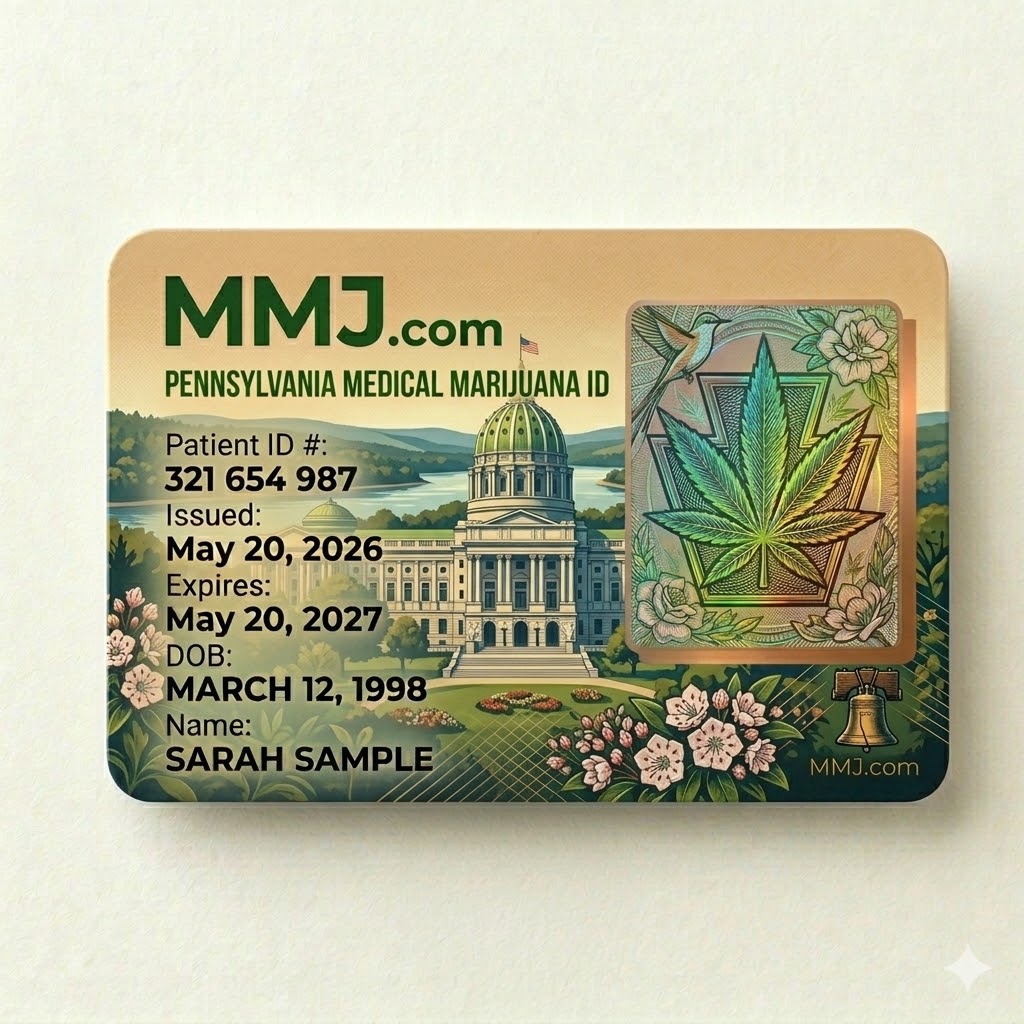
How to Get a Medical Marijuana Card in Pennsylvania

  1. Create a patient profile at the Pennsylvania Medical Marijuana Registry — requires PA driver's license or state-issued ID
  2. See an approved physician (in-person or telehealth, now permanently authorized) who evaluates your qualifying condition and submits certification to the state
  3. Receive confirmation email from PA DOH
  4. Log into registry and pay the $50 state fee (waivable for qualifying low-income patients)
  5. Receive your card — digital copy within ~7 days; physical card mailed within 1–3 weeks
  6. Visit any licensed dispensary with card and state ID

Costs:

ComponentAmount
State registration card$50/year
Doctor consultation/certification$45–$350 (typical: $99–$199)
Total first-time cost~$100–$400
Annual renewal (state + doctor)$50 + $45–$199

The Medical Marijuana Assistance Program (MMAP) waives the $50 annual fee for patients enrolled in Medicaid, PACE/PACENET, CHIP, SNAP, or WIC, and provides a $50 monthly benefit toward medical marijuana purchases for qualifying patients.

Get Your Pennsylvania Medical Marijuana Card Today

If you have a qualifying condition, MMJ.com can connect you with an approved Pennsylvania physician for a convenient telehealth evaluation. With recreational legalization still stalled in the legislature, a medical card remains the only legal path to purchasing cannabis in Pennsylvania.

  1. Schedule your evaluation through MMJ.com — telehealth appointments available statewide
  2. Get certified — your physician submits your certification directly to the state registry
  3. Pay the $50 state fee and receive your card
  4. Visit any of Pennsylvania's 185 licensed dispensaries — no state sales tax on medical purchases

With 24 qualifying conditions including anxiety, chronic pain, PTSD, and cancer, more Pennsylvanians qualify than ever before. Start your evaluation today.

Arrest Data Reveals the Human Cost of Prohibition

Cannabis arrests remain a persistent and racially inequitable feature of Pennsylvania's criminal justice system despite legalization in nearly every neighboring state.

Annual cannabis arrest data (FBI UCR/NIBRS):

YearPossessionSales/ManufacturingTotal
201823,9254,15928,084
202020,2001,80822,008
202210,6941,68012,374
202311,2341,64212,876
202411,1541,55312,707

Over the last decade (2013–2024), at least 154,491 adults were arrested for cannabis possession and 27,222 for sales/manufacturing. Pennsylvania ranked as the third-highest state for marijuana possession arrests in 2024, behind only Texas and Tennessee. Cannabis possession accounted for 45% of all substance possession arrests in the state and 20% of all drug arrests.

Racial disparities remain stark. The ACLU of Pennsylvania's "Cannabis Crackdown" report found that Black adults were 3.6 times more likely to be arrested for marijuana possession than white adults statewide. Outside Philadelphia, across the state's other 66 counties, the disparity was 6.1 times greater. The disparity increased every year from 2010 to 2016, despite survey data consistently showing similar usage rates between Black and white populations.

Enforcement costs are estimated at more than $100 million per year in taxpayer spending on low-level marijuana enforcement and more than $1 billion over the last decade. Shapiro's budget proposes immediate expungement for those incarcerated solely for possession — with 154,491+ possession arrests in the last decade alone, the universe of people with active cannabis records numbers in the hundreds of thousands.

Pennsylvania finds itself nearly surrounded by legal recreational cannabis markets, creating significant economic pressure and a steady outflow of consumer spending.

StateRec Sales Start2024 Revenue2025 Revenue (est.)Tax Rate
New JerseyApril 2022$1+ billion (combined)~$1.05B+ rec6.625% + municipal
New YorkDecember 2022~$927M adult-use~$1.6 billion9% wholesale + 13% retail
MarylandJuly 2023~$860M dispensary sales~$1.1 billion9% to 12% (July 2025)
OhioAugust 2024$242M (5 months)$836M rec ($1.06B total)10% excise
DelawareAugust 2025N/A (launched Aug 2025)Early stage15%
West VirginiaN/AMedical onlyMedical onlyN/A

New Jersey surpassed $1 billion in combined cannabis sales by December 2024. New York's market exploded in 2025, with 556 dispensaries open by year-end and a record $214.4 million in single-month sales in August 2025. Ohio's market hit $1.06 billion total in its first full calendar year. Maryland projects over $100 million in annual cannabis tax revenue for fiscal year 2025. Delaware launched August 1, 2025, generating $903,000 in its opening weekend.

Governor Shapiro has cited these numbers directly: "Five of our neighboring states have legalized adult-use cannabis. I've talked to CEOs of the companies right across the border, in Jersey, in Maryland, in New York, who tell me that up to 60% of their customers in those shops are Pennsylvanians."

Rep. Dan Frankel (House Health Committee Chair): "We are literally surrounded by every state around us that has legal weed, so we're bleeding out revenue from the state to other states that are benefiting from their legalization."

Job Creation and Economic Impact Projections

Multiple analyses project significant economic impact from Pennsylvania legalization:

SourceAnnual Tax RevenueFirst-Year RevenueJobs Created
Shapiro 2026 Budget$200M+ (mature market)$729.4M (incl. licensing)Not specified
PA Independent Fiscal Office$250M+ (mature)$41M (ramp-up year)Not specified
FTI Consulting / ResponsiblePA$420M annually$2.1B in sales33,000+
Leafly~$500MN/A32,800–47,100
MPP$320–610M (Year 4)$105–236MNot specified

FTI Consulting's analysis projected $4.2 billion in total economic output with 33,000+ new jobs and $2.1 billion in first-year sales. Pennsylvania's existing medical program already supports roughly 25,000 jobs across 32 grower/processors and nearly 200 dispensaries.

Public Opinion Strongly Favors Legalization

A Change Research poll (January 2025, 1,129 registered Pennsylvania voters) found:

  • 68% support adult-use legalization (rising to 74% after learning more)
  • By party: Democrats 85%, Independents 62%, Republicans 53%
  • By age: 18–34: 78%; 35–49: 77%; 50–64: 75%; 65+: 69%
  • 57% support private retail, 25% favor state stores

The Muhlenberg College Public Health Survey (March 2025) found 52% favor legalizing marijuana for any purpose — the highest ever since the survey began in 2013. The Franklin & Marshall College Poll (January 2024) found 63% support recreational legalization. Nationally, Gallup's October 2025 survey shows 64% of Americans support legal marijuana, with ~90% supporting legalization in some form per Pew Research.

Trump's December 2025 Executive Order Changes the Federal Calculus

On December 18, 2025, President Trump signed an executive order directing the Attorney General to expedite rescheduling marijuana from Schedule I to Schedule III. Trump at the signing: "We have people begging for me to do this," mentioning veterans and seniors. He emphasized: "It doesn't legalize marijuana in any way, shape or form."

Current status (February 2026): The DEA clarified on January 6, 2026 that "the rescheduling matter remains pending and must still proceed through required administrative steps." A Trump insider told Marijuana Moment on January 29 that the DEA rule is coming "ASAP," but DOJ stated on January 30 it had "no cannabis rescheduling update."

What Schedule III means for PA patients and businesses: The most significant immediate impact would be eliminating the IRS Section 280E tax burden — under which cannabis businesses can't deduct ordinary expenses, pushing effective tax rates as high as 80%. Maryland cannabis retailers estimate average savings of $805,000 per store annually if 280E is removed. For patients, rescheduling would mean federal law acknowledges cannabis has medical value for the first time in nearly a century.

Meredith Buettner (PA Cannabis Coalition): "The signals that are coming out of Washington are that it is going to happen... I think that has kind of helped in changing the tone of the conversation here in Harrisburg."

The Path Forward Runs Through a Divided Capitol

The fundamental obstacle remains the split legislature — a razor-thin 102–101 Democratic House majority against a 27–23 Republican Senate majority. House Democrats passed a state-run stores model; Senate Republicans insist on private retail. The bipartisan bills (SB 120, HB 20) that could bridge this gap use private retail models, but neither has been scheduled for a hearing.

Chris Goldstein, NORML regional director, is blunt about the impasse: "We are still spinning our wheels in Pennsylvania. I don't see the traction that's required to advance the legislation... With the split between the Senate and the House, the whole strategy for legalization at this point is so far apart. I don't think it's ever been further apart."

Senate Majority Leader Joe Pittman (R) remains the primary obstacle: "I do not see a prevailing view for legalization of recreational marijuana within our caucus as part of the current budget."

Yet several dynamics could shift the calculus in 2026. Pennsylvania's $5.1 billion structural deficit makes $729 million in first-year cannabis revenue increasingly difficult to ignore. Trump's rescheduling executive order removes the federal-law-conflict argument. And the steady accumulation of neighboring-state revenue data sharpens the competitive pressure daily.

For the nearly 12,700 people arrested for marijuana offenses in 2024 and the hundreds of thousands with cannabis records, every month of delay carries real consequences. The state's medical marijuana program — with 439,000+ patients, 185 dispensaries, $1.7+ billion in annual sales, and a decade of operational infrastructure — provides a ready-made foundation for adult-use expansion. With 68% of voters supporting legalization and five of six neighboring states already reaping the economic benefits, Pennsylvania's prohibition increasingly looks like an outlier — one measured not just in lost revenue but in thousands of ongoing arrests, racial disparities, and economic opportunities flowing across state lines.

Until the legislature acts, a Pennsylvania medical marijuana card remains the only legal way to purchase cannabis in the Commonwealth.


Frequently Asked Questions

No. As of February 2026, recreational marijuana remains illegal in Pennsylvania. Governor Shapiro has proposed legalization in three consecutive budget addresses, and the House passed a legalization bill (HB 1200) in May 2025 for the first time ever, but it was killed in the Senate. A medical marijuana card is currently the only legal path to purchasing cannabis in the state. Learn more about Pennsylvania's marijuana laws.

What conditions qualify for a PA medical marijuana card?

Pennsylvania recognizes 24 qualifying conditions, including anxiety disorders, severe chronic pain, PTSD, cancer, epilepsy, autism, opioid use disorder, Crohn's disease, multiple sclerosis, Parkinson's disease, and more. Anxiety is the most common qualifying condition, cited by 60% of cardholders. See the full list of qualifying conditions.

How much does a Pennsylvania medical marijuana card cost?

The state registration fee is $50 per year (waivable for patients enrolled in Medicaid, SNAP, WIC, or other qualifying programs). The physician consultation typically costs $99–$199. Total first-time cost ranges from approximately $100 to $400. The Medical Marijuana Assistance Program (MMAP) also provides a $50 monthly benefit toward purchases for qualifying low-income patients. Get started with MMJ.com.

Will Pennsylvania legalize recreational marijuana in 2026?

It's uncertain. Governor Shapiro proposed legalization effective July 1, 2026, with sales beginning January 1, 2027. However, the legislature remains deeply divided — House Democrats and Senate Republicans disagree on the retail model (state-run stores vs. private retail). Bipartisan bills (SB 120, HB 20) that use private retail models exist but haven't been scheduled for hearings. The state's $5.1 billion structural deficit may create pressure to act, but Senate Republican leadership has signaled no urgency.

Can I use telemedicine for a PA medical marijuana evaluation?

Yes. Pennsylvania permanently authorized telehealth evaluations for medical marijuana certifications. You can complete the entire process — from physician consultation to receiving your certification — without an in-person visit. Schedule a telehealth evaluation through MMJ.com.

How many dispensaries are in Pennsylvania?

Pennsylvania currently has 185 operational dispensaries run by more than 40 companies, along with 30 operational grower/processors. This extensive network makes it one of the largest medical-only dispensary markets in the country. Medical marijuana retail sales are not subject to state sales tax, providing cost savings compared to what recreational consumers would pay in neighboring states.


This article was last updated February 6, 2026. MMJ.com will continue to update this page as legislative developments unfold, new bills are filed, and the legalization debate evolves in Harrisburg.

Pennsylvania Cannabis Sources and References

Governor's Office & Budget:

  1. PA Governor's Office — 2026 Budget Address (February 3, 2026) — Revenue projections, legalization framework, expungement proposals
  2. Spotlight PA — Legislative analysis, budget impasse coverage, cannabis policy reporting
  3. PhillyVoice — Cannabis Legalization Coverage (February 2026) — Stakeholder interviews, Chris Goldstein and Meredith Buettner quotes, SB 120 status
  4. ABC27/WHTM — Budget address coverage

Legislative Bills & Analysis: 5. PA Legislature — HB 1200, SB 120, HB 20 Bill Texts — Full bill texts, vote records, committee actions 6. PA Senate Republicans — Sen. Laughlin and Sen. Pittman statements on cannabis legislation 7. Cannabis Business Times — Pennsylvania Coverage — Legislation comparisons, industry analysis 8. PA Capital-Star — Legislative process reporting

Medical Program Data: 9. PA Department of Health — Medical Marijuana Program — Patient enrollment, dispensary counts, qualifying conditions 10. PennsylvaniaStateCannabis.org — Program statistics, sales data, pricing trends

Arrest & Criminal Justice Data: 11. NORML — Pennsylvania Arrest Data — FBI UCR/NIBRS cannabis arrest statistics, enforcement cost estimates 12. ACLU of Pennsylvania — "Cannabis Crackdown" Report — Racial disparity data, 3.6x arrest rate for Black adults 13. Marijuana Policy Project — Pennsylvania — State policy analysis, arrest rankings

Neighboring State Revenue: 14. NJ Cannabis Regulatory Commission — New Jersey sales data ($1B+ in 2024) 15. NY Office of Cannabis Management — Annual Report — 556 dispensaries, $2.5B cumulative sales 16. Ohio Capital Journal — Ohio recreational market data ($1.06B in 2025) 17. Maryland Comptroller — Maryland cannabis tax revenue

Polling & Public Opinion: 18. Change Research / ResponsiblePA Poll (January 2025) — 68% support, partisan and demographic breakdown 19. Muhlenberg College Public Health Survey (March 2025) — 52% favor legalization, highest ever recorded 20. Franklin & Marshall College Poll (January 2024) — 63% support recreational legalization 21. Gallup — Americans' Views on Drugs (October 2025) — 64% national support, partisan trends

Federal Context: 22. White House — Executive Order on Marijuana Rescheduling (December 18, 2025) — Rescheduling directive 23. DEA — Rescheduling Status Clarification (January 6, 2026) — Administrative process timeline 24. Marijuana Moment — Rescheduling Updates — Trump insider statements, DOJ status updates

Economic Projections: 25. PA Independent Fiscal Office — $250M annual revenue projection, structural deficit analysis 26. FTI Consulting / ResponsiblePA — $4.2B economic output, 33,000+ jobs projection 27. Leafly — Pennsylvania Economic Impact — 32,800–47,100 jobs estimate

About the Author

This article was written by the MMJ.com Medical Team, a group of licensed healthcare professionals specializing in medical cannabis certification. Our team has helped over 10,000 patients obtain their medical marijuana cards.

Found this helpful? Share it!

Share:

Get your medical marijuana card online

MMJ.com connects patients with licensed physicians for fast, legal medical cannabis evaluations. See if you qualify in minutes.

See if you qualify